
Contents
More from Artificial Intelligence

5 Steps to Get Started with AI Products

Category: Artificial Intelligence | Tags: #Podcast, #AI
What exactly is an AI product, and how do we create them? How do we go from talk to something that delivers value? In this article, we explore what needs to be in place to develop an AI product, based on experience.
From AI hype to practical application
A major challenge with AI today is that many see it as hype without understanding its real potential. AI can improve many cognitive tasks, but to realize its potential you need a clear strategy. Where we find that AI can make a significant difference in supporting decisions or automating processes, we want to develop AI products.
We describe here 5 steps for developing an AI product, but first – what are AI products?
AI products
What is a data product – and an AI product?
A product in the IT world is a piece of software or digital application that contains an interface, has functionality and uses input to generate output, such as an application or digital service.
Data products are products where data is the output, either as raw data or refined data, such as click analytics from a website or a prediction model. An AI product is a type of data product that uses artificial intelligence for tasks such as image recognition, recommendation systems and prediction models.
AI products are a subset of data products, but stand out due to the need for ethical assessment and specific capabilities for training and monitoring.
Examples of AI products from Norwegian organizations
AI is becoming increasingly integrated into Norwegian organizations, which use the technology to solve real problems, improve services and thereby increase revenue or reduce costs.
Here are some concrete examples from various industries where AI has been used over time:
| Sector | Organization | Use |
|---|---|---|
| Public services | NAV | Prediction models are used to identify people at risk of falling out of the labor market, so that measures can be implemented early. |
| Telecommunications | Telenor | Network optimization by predicting and resolving potential problems before they affect customers. |
| Groceries | Oda | Prediction model to forecast which items customers will buy, based on previous purchase history. |
| Media | Schibsted | Personalized recommendations for articles and other content based on user data. |
| Transport | Statens vegvesen | Analyzes traffic data to improve traffic safety. |
| Energy | Equinor | Analyzes geological data to improve oil and gas exploration. |
| Public transport | Ruter | Optimizes inspections and understanding root causes of customer complaints. |
These examples show how Norwegian organizations and public institutions use AI products such as chatbots, predictive analytics and network optimization.
But have you started?
5 steps for how you can get started with AI products
Here are 5 steps to get started the right way with developing AI products, based on many years of experience from organizations that have come far in their maturity journey for using AI:
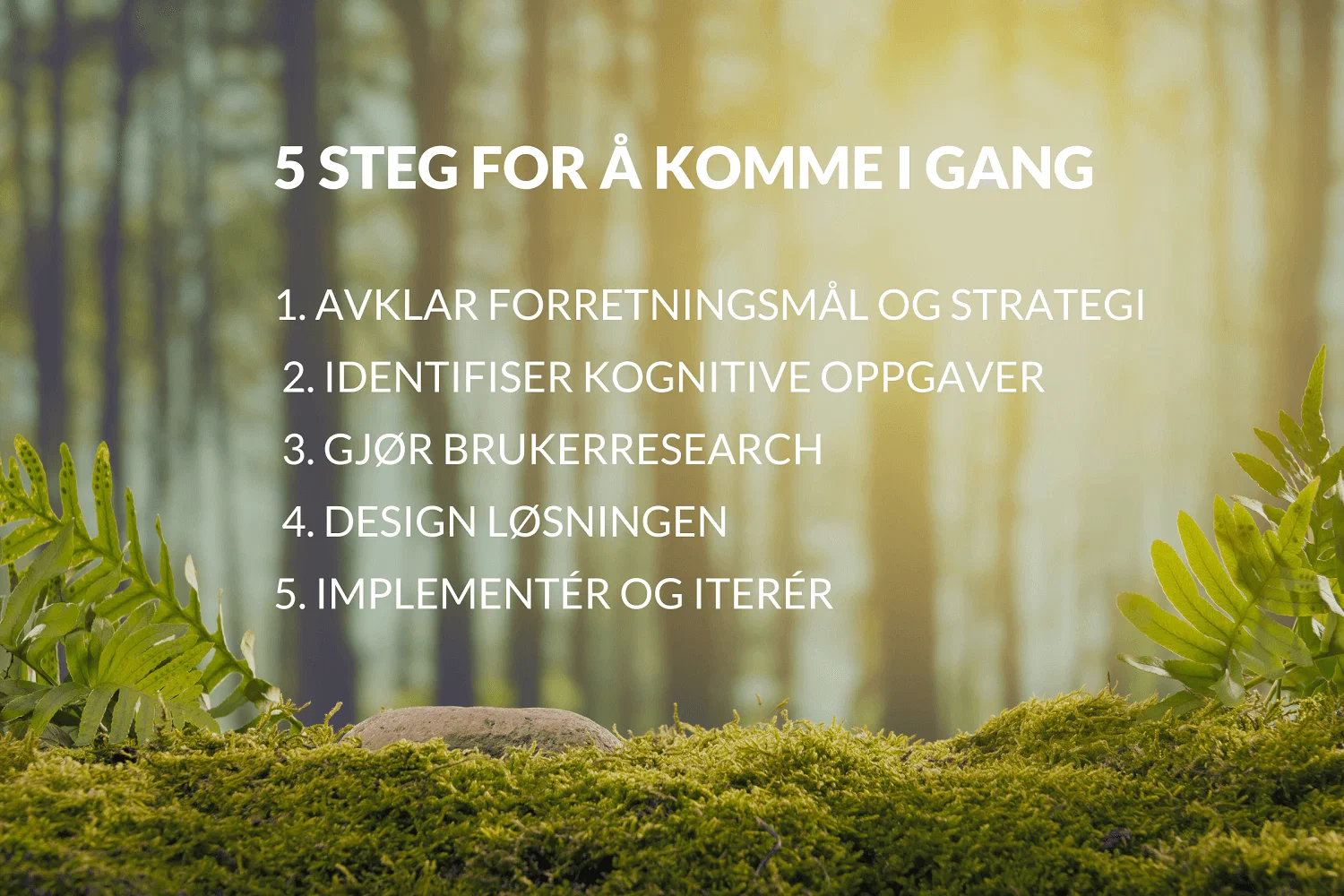
1. Clarify business objectives and strategy
Start by identifying and clarifying business objectives, and assess where AI could make a significant difference. This involves identifying which tasks can be automated or improved using AI. It is important that the strategy facilitates AND plans for capturing efficiency gains by automating, streamlining or improving cognitive tasks.
2. Identify cognitive tasks
Look for areas where a lot of cognitive work is being performed. This can be in both end-user products and internal processes. Identify where there is a need to think and make decisions. Oda, for example, created a prediction model that forecasts what customers would buy, based on their behavioral patterns, which drives up customers’ purchase frequency and average basket size.
3. Conduct user research
Carry out thorough research to understand what information a person needs to solve the identified tasks. This can include interviews, observations and analysis of existing data. Go out and talk to people, find out how they think and what they need to achieve their goals.
4. Design the solution
Based on the findings from the research, design a solution that provides both the AI and the human with the information they need to solve the task. It is important to create a Minimum Viable Learning Product (MVLP) so that the solution can learn and improve over time. Also consider how we can ensure that the AI product complies with requirements for ethical design (AI Act can provide guidance).
5. Implement and iterate
Start with small projects to reduce risk and learn along the way. Build up the infrastructure gradually, and ensure that both the team and the technology are ready to scale up when pilot projects show success.
Conclusion
Machine learning is easy – business development is hard
Although machine learning and AI may seem complex, it is important to understand that the technology itself is accessible and relatively straightforward to implement. There are many consultants and tools that can help you get started. The real challenge lies in clarifying business objectives, identifying cognitive tasks, and conducting thorough user research – tasks that require deep business development and change management competence.
Quick results make working with AI exciting
Working with AI offers the opportunity to see concrete results quickly. You can automate time-consuming tasks, improve decision-making processes and create better user experiences. When you combine the power of AI with solid business development, you can truly make a difference.
AI is a new core technology that EVERYONE must engage with
To fully leverage AI, we must think of AI as a core technology that can change how we work. This means changing old working methods and ways of thinking. By focusing on what users truly need and how we can automate their cognitive processes, we can develop products that truly create value.
Want to learn more?
Listen to the podcast “Datautforskerne”, episode 5 where Kjetil Amdal-Saevik and Magne Bakkeli discuss AI products. The episode is available on Spotify, Apple and Acast.
Like and subscribe!