Interfaces first: sharing and data contracts

Tags: #data products, #data contract
The data product is the interface – the engine room should be refactorable without consumers noticing.
The data product is the interface
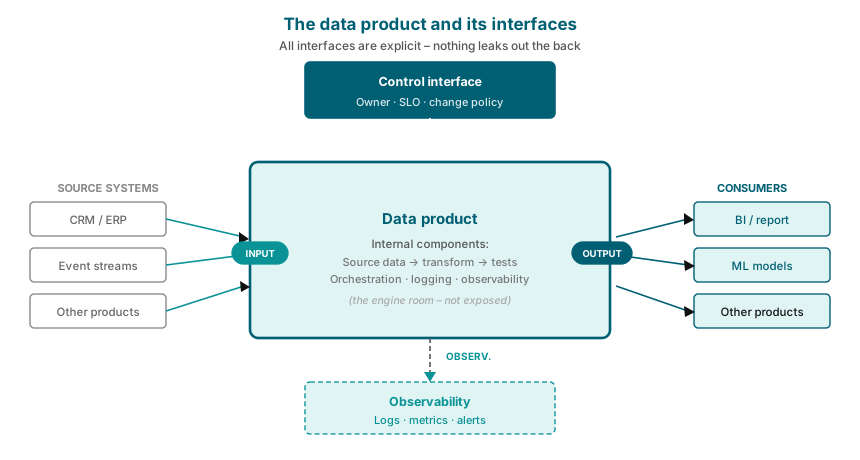
A data product is an interface towards consumption. Everything behind the interface is implementation, and should be free to change without making customers nervous.
In practice this is the difference between:
- “we daren’t touch anything, because everything is intertwined”
- “we can improve the engine room without phoning half the organisation”
If you take the interface seriously, sharing becomes easier, change becomes less dramatic, and people stop creating copies “just in case”.
Outside vs inside
Outside (product surface) is what you stand behind over time: semantics, keys, time logic, recommended consumption path, change practice and expectations.
Inside (engine room) is everything you should be able to change frequently: staging, intermediate layers, pipelines, optimisation and refactoring.
Table, model, dataset and dashboard
- Table/view is a delivery format. Some tables are product surface. Many are internals.
- Model is how you produce the deliverable. The model is rarely a promise to the customer.
- Dataset is a useful umbrella term, but imprecise as a product surface if it does not state what is official.
- Dashboard is presentation. It is typically a consumer, not a data product.
The point is to be able to say: “This is the supported surface. The rest is engine room.”
How do we share data products within domains, across domains and externally?
A data product that cannot be shared is, in practice, an internal deliverable. And sharing is more than “publishing in the catalogue”.
Sharing consists of three steps:
- Find
- Understand
- Get access
Many organisations improve only step 1 and are surprised that self-service does not happen. The catalogue looks nicer. Day-to-day life does not get easier.
The sharing journey: what needs to be in place?
Check whether you actually offer a complete sharing journey before discussing tools and catalogues.
On the product side, you must answer three questions:
- What is this (and what is it not)?
- How do I use it? (recommended consumption path + example)
- What can I expect? (access, refresh, quality signal, change)
If you cannot answer these briefly, sharing ends up as private messages and verbal explanations. Social capital as an integration layer.
Sharing within a domain
Within a domain, people have more context, a shared vocabulary and a shorter path to sources. A simple practice works, as long as it is clear:
- shared entry point in the catalogue
- clear distinction between product surface and component
- short path to a point of contact
- simple change practice
This is not about “more documentation”. It is about the right type of signal in the right place.
Sharing across domains: meaning before schema
Across domains, context disappears. What was “obvious” suddenly becomes a source of misunderstanding.
You then need to be precise about:
- terms (semantics)
- keys and time logic
- constraints
- change/notification
Sharing without shared terms rarely produces reuse. It produces copies.
If you only share schema, you often just share the ability to misunderstand faster.
Take Customer 360 – Core as an example: it is precisely across domains that “who is a customer?” stops being obvious. The CRM team, customer service and sales analytics all have their own variant. A Type A product with stable semantics and controlled keys is the answer, not yet another join.
External sharing
If you share externally, expectations change: the cost of errors becomes more apparent, and compliance is often what drives product surface and access decisions.
Contract, change and support must be explicit. A good sign of maturity is that you can answer:
- Who do we notify when something changes?
- What counts as “breaking” for external consumers?
- Who receives support enquiries, and what is the normal response time?
What counts as breaking, and how to handle transitions, is covered in chapter 8 on change and deprecation.
Data contract: use it when risk and dependency warrant it
Data contracts are not a goal in themselves. They are a tool for predictability when “hoping for the best” becomes too expensive.
Consider introducing contracts when:
- multiple teams are dependent
- the cost of errors is high
- change happens frequently
The more dependencies, the higher the risk and the more frequent the change, the greater the likelihood that you need a data contract. In many cases, a “contract light” suffices for a long time: the fields people misunderstand, keys/time logic, and change practice.
The next step is to make the product visible and usable in the catalogue: In practice: product page, catalogue and components.
