Quality and reliability

Tags: #data products, #data quality, #SLO for data, #data observability
Three tiers, a handful of SLOs, and a response that makes people trust the product.
Quality is part of the product promise
When you say something is a data product, you are also saying that others can use it over time — without having to guess about freshness, changes or quality.
This chapter is not about “perfect data”. It is about making the promise clear and operable:
- what does “good enough” mean for the named use?
- what is measured to detect deviations early?
- what happens when deviations occur?
Data quality can easily become a discussion without boundaries. In data products, the boundaries should be simple:
Quality = good enough for a named use, for a named customer group.
That makes it possible to be concrete. For most data products, three things matter most:
- Freshness: data arrives when it is needed
- Stability in semantics/keys/time logic: what you mean by “order”, “customer”, “revenue” does not change without control
- Quality signal: customers can see whether the product is “ok”, “degraded” or “stopped”
Tiers: not everything should have the same rigour
If you put the same requirements on everything, you typically end up with either too much governance — or too little credibility. Three tiers are usually enough to be precise without becoming heavy.
Exploration Data is used to learn and test hypotheses. The point here is to be clear that the promise is limited: frequent changes are acceptable, and you primarily need visibility (status + basic metrics).
Standard Data is used in reporting and ongoing decisions. Here you should promise stable semantics for a defined use, and have a few tests/alarms you actually respond to.
Business-critical Errors carry high cost or high risk. Here the promise must be sharper: clear SLOs, a defined response to deviations and controlled change. See chapter 8 on change and deprecation for how to handle this in practice.
Take Customer 360 – Core as an example: the named consumers (the sales team and customer service) have different tolerances. The sales dashboard can tolerate a one-day-old figure. The customer service system cannot. That means two SLOs, not one shared requirement.
SLOs: promises you can measure and follow up
SLOs work best when you are strict on quantity. Start with 2-4 per data product.
Most data products need no more than these categories:
- Freshness (refresh)
- Availability (readability)
- Quality signal (a few indicators that match the use)
SLO must be tied to measurable indicators:
- minutes since last successful refresh (freshness)
- proportion of successful read attempts against the product surface (availability)
- proportion of null/invalid keys, duplicates on business key or invalid status values (quality signal)
The most important thing is not to choose the “right” metric on the first attempt — the most important thing is that you choose something you follow up on.
Response to deviations: stop, degrade or signal
Quality only becomes real when you have a clear response. Three response types suffice:
- Stop: Used when the risk of misuse is high, or when errors have major consequences. The product is not published as “ok” if critical gates fail.
- Degrade: Used when the product can still be used, but with a clear limitation (for example “stale”, or a known portion of the content has deviations). Status must be visible on the product page.
- Signal: Used when risk is low, or during exploration. Deviations are made visible and notified, but without automatically blocking use. The point is that customers should not have to guess about the state.
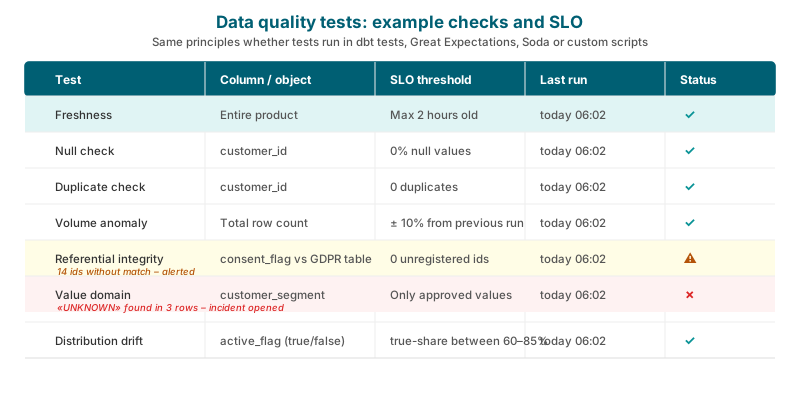
Tests: a few that match the use beat many generic ones
Start with 3-7 validations that match the use of the product surface:
- mandatory fields
- unique keys (where uniqueness is expected)
- valid values (status/enum)
- referential integrity (where relevant)
- one or two business rules that cause errors or misunderstandings
If you do not have a defined response to a failing test, that is a signal that the test is either poorly chosen — or that the threshold/responsibility is unclear.
Minimum for operability: a short runbook
For data products shared across teams, a short runbook is sufficient:
- point of contact + responsible team
- what does “stopped” and “degraded” mean for this product?
- most common failure sources (upstream/transform/access)
- where status and changelog are updated
The purpose is that both the owner team and customers get a predictable handling process — not that you write a manual.
The next step is to decide how you handle changes and deprecation without losing consumers’ trust: Change and deprecation of data products.
