Product forum, 100 days and Learn more

Tags: #data products, #product forum data, #data product owner
Cadence, decisions and further reading on data products.
Product forum for data: decisions, backlog and change/deprecation
If data products are to be more than labels in a catalogue, you need one place where decisions are actually taken: prioritisation, semantics, change and deprecation.
A product forum for data is a forum that prioritises and decides on changes to the product surface — based on customers, value and risk.
The forum should cover the following:
- regular meeting place for the data products you manage
- prioritisation based on customers and value hypothesis
- arena for landing definitions/keys/time logic
- practice owner for change/deprecation (notification, transition, deprecations)
What the forum decides
The forum decides on:
- semantics
- keys and time logic
- change/deprecation (breaking vs non-breaking)
- expectations (tier, freshness, availability)
- quality gates and response to deviations
| Input (case) | Output (decision) |
|---|---|
| product, customers/value, what changes in product surface, breaking?, proposed notification/transition | decision, responsible, plan, notification (where/when), update in catalogue/contract/examples |
Who should be there
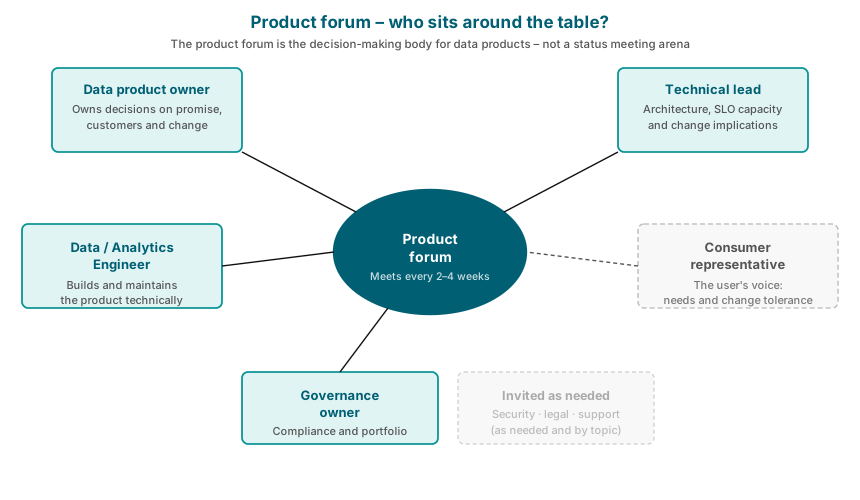
The goal is enough expertise in the room to resolve cases:
- someone who knows the data and the usage (consumer perspective)
- someone who can deliver from the source (source system/source team)
- someone who owns the data products (owner team)
- someone who contributes information management (concepts/definitions)
- someone who contributes data engineering (delivery, operability)
Cadence
Start simply:
- every fortnight, 30-45 minutes
- focus on product surface changes and cross-team clarifications
- what the owner team can decide on its own, the owner team decides on its own
The first 100 days as a data product owner
The one sentence
The goal is a data product that people dare to use, that can withstand change, and that can be managed without constant firefighting.
Define this early, then plan accordingly: “This data product helps [customer group] achieve [end result] by offering [product surface], and we promise [tier] within [scope].”
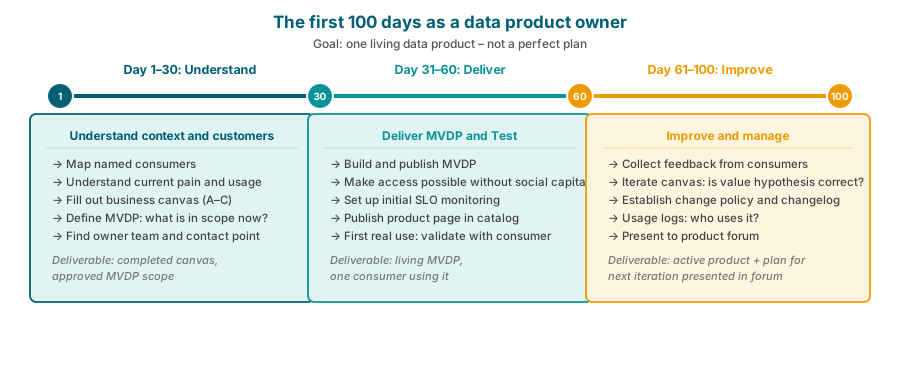
Days 1-10: Make the product steerable
| Purpose | Deliverables | Priorities | Exit criterion |
|---|---|---|---|
| Control over why/who/what you promise | Product brief + product page (minimum) + point of contact | name customers, define scope, choose product surface, assign decision responsibility | A new consumer understands what it is and who picks up the phone |
Days 11-30: Make the promise testable
| Purpose | Deliverables | Priorities | Exit criterion |
|---|---|---|---|
| Detect errors before customers do | Contract-light v0.1 + 3-5 quality rules + access pattern | define misunderstood fields, implement validations, clarify access | Access is predictable, key logic is understandable, tests run |
Days 31-60: Make the product reliable and changeable
| Purpose | Deliverables | Priorities | Exit criterion |
|---|---|---|---|
| Predictable operations and change | 2-3 SLOs + changelog + change policy + status signal | set tier, choose SLOs, define response to deviations | Changes are not discovered after the fact; status is visible |
Days 61-100: Make the product living
| Purpose | Deliverables | Priorities | Exit criterion |
|---|---|---|---|
| Prioritise by real customer value | Customer forum + simple backlog + 1-3 value metrics + templates | monthly 30-minute forum, prioritise hard, track adoption/impact/cost | Customers attend, prioritisation is stable, the next product launches faster |
Learn more
From Glitni
This guide builds on and complements a number of articles we have written on related topics:
- A guide to data mesh – domain thinking, ownership and distributed architecture
- Data governance and data ownership – governance models and role clarification
- Guide to data contracts – format, content and when it is worth it
Product thinking for data
- “Approach Your Data with a Product Mindset” (Harvard Business Review, 2020): https://hbr.org/2020/05/approach-your-data-with-a-product-mindset
- Perri, Melissa (2018). Escaping the Build Trap. Portfolio / Penguin Random House: https://page.place/pmc/escaping-the-build-trap/preview
- Skelton, Matthew & Pais, Manuel (2019). Team Topologies. Team Topologies (official site): https://teamtopologies.com/
Data products in practice
- Gioia, Gabriele & Scotti, Davide (2024). Managing Data as a Product. Packt: https://www.packtpub.com/en-us/product/managing-data-as-a-product-9781835468602
- Dehghani, Zhamak (2022). Data Mesh: Delivering Data-Driven Value at Scale. Google Books: https://books.google.com/books/about/Data_Mesh.html?id=HsNvEAAAQBAJ
- Perrin, Jean-Georges & Broda, Eric (2024). Implementing Data Mesh. Amazon: https://www.amazon.com/Implementing-Data-Mesh-Discover-solutions/dp/1098166140
- Goedegebuure et al. (2024). “Data Mesh: A Systematic Gray Literature Review”. ACM Computing Surveys (DOI): https://doi.org/10.1145/3687301
Contracts and “interfaces first”
- Sanderson, Freeman & Schmidt (2025). Data Contracts. (link to book page): https://books2read.com/DataContracts
- Open Data Contract Standard (ODCS) v3.1.0 (specification): https://bitol-io.github.io/open-data-contract-standard/v3.1.0/
- Prakash, Kiran (2024). “Designing data products”. Martin Fowler: https://martinfowler.com/articles/designing-data-products.html
- Prakash, Kiran (2024). “Governing data products using fitness functions”. Martin Fowler: https://martinfowler.com/articles/fitness-functions-data-products.html
Quality and reliability
- Google SRE Workbook – “Implementing SLOs”: https://sre.google/workbook/implementing-slos/
- Wang, Richard Y. & Strong, Diane M. (1996). “Beyond Accuracy: What Data Quality Means to Data Consumers”. Journal of Management Information Systems: https://www.semanticscholar.org/paper/Beyond-Accuracy%3A-What-Data-Quality-Means-to-Data-Wang-Strong/b057cc625984119d48846dbf08f30b565f8c263d
- ISO/IEC 25012 (2008). Data quality model (standard overview): https://www.iso.org/standard/35736.html
- Wilkinson et al. (2016). “The FAIR Guiding Principles for scientific data management and stewardship”. Scientific Data: https://europepmc.org/article/med/26978244
Metadata and catalogue
- Digitaliseringsdirektoratet – DCAT-AP-NO (specification): https://data.norge.no/specification/dcat-ap-no
- W3C (2024). Data Catalog Vocabulary (DCAT) – Version 3 (Recommendation): https://www.w3.org/TR/vocab-dcat-3/
- Open Data Product Specification (ODPS) (specification): https://github.com/opendataproducts/open-data-product-specification
- Data Product Descriptor Specification (DPDS) – Open Data Mesh Initiative: https://github.com/opendatamesh-initiative/dpds
