
Contents

Data Mesh | A Complete Guide to the Four Principles

Category: Data Strategy | Tag: #data mesh
Data mesh is not technology — it is a framework for data organization based on domain ownership, data as a product, federated governance and self-serve. Learn what it requires in practice.
A CDO I spoke with recently summed up the situation in one sentence: “We have a great platform. But the central data team is still the bottleneck for absolutely everything.”
The organization had invested three years in a modern data platform. Good technology. Well-designed pipelines. But the domains did not own their own data. Sales needed sales data delivered by someone else. Logistics was waiting for someone to process supply chain data. The central data team was drowning in requests, and the analyses coming out the other end were too old to drive real decisions.
The answer was not more technology. It was a shift in who owns and delivers data.
That is data mesh.
What is data mesh?
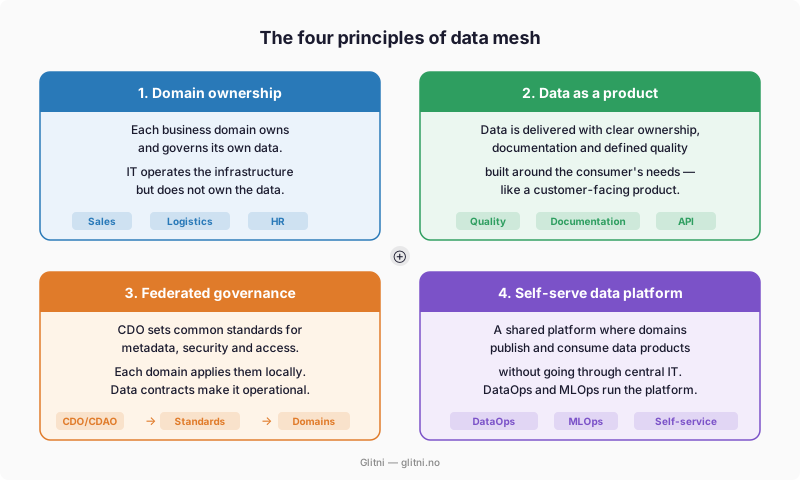
Data mesh is an organizational and architectural framework in which responsibility for data is moved from a central data team to the business domains that actually create and use the data. It rests on four principles: domain ownership, data as a product, federated governance, and a self-serve data platform.
The concept was introduced by Zhamak Dehghani through the article “How to Move Beyond a Monolithic Data Lake to a Distributed Data Mesh” in 2020, and expanded in the book Data Mesh: Delivering data-driven value at scale in 2022.
Data mesh is not a technology. It is not a product you install. It is an organizational model that requires technology, ownership and processes to develop in concert. A change in architecture without a corresponding change in ownership is just new infrastructure with the same problems.
From architectural theory to operational reality
In 2023, data mesh was a concept most organizations discussed in theory. Pioneers were testing it. Nobody was entirely certain what it required in practice.
In 2026, the picture has changed. In the organizations we work with, a majority are now either operating according to data mesh principles or moving actively in that direction. And we see a clear pattern: those who succeed do not start with technology. They start with ownership.
Those who fail do it the other way around. They build self-serve platforms and domain isolation technically, but leave ownership with the same central team. The bottleneck shifts, but does not disappear.
Data mesh as an organizational model works. Data mesh as an architecture exercise rarely does.
The problems data mesh seeks to solve
The fundamental problem is scaling. When an organization grows in data volume and business complexity, a central data team cannot handle all the needs of all domains. They try. But they end up as the bottleneck.
There is a classic knowledge gap here: IT has strong technical skills but does not always see what the business side actually uses data for. The business side knows the processes well but rarely understands what is in the data sources or what quality they hold. Data initiatives end up as technical exercises that do not deliver business value, because nobody owned the connection between the two.
Data mesh is the answer to this. Not by making IT better, but by moving responsibility to where it belongs: the domains that create and use the data.
The four principles of data mesh
Principle 1: Domain ownership
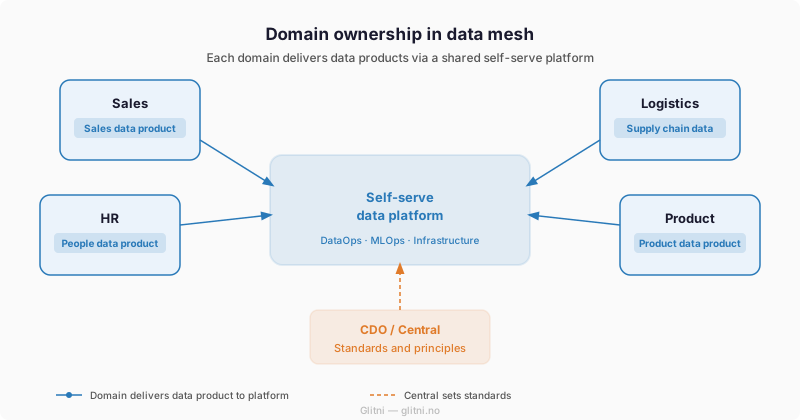
Instead of centralizing responsibility for all data in one data team, data mesh requires that each business domain owns its own data. The sales domain owns sales data. The logistics domain owns supply chain data. IT operates the infrastructure but does not own the data.
This is an important distinction. A domain that owns its data is responsible for producing it at sufficient quality, making it available to others, and ensuring it is properly documented and governed. Ownership without mandate and capacity is just a title change.
For more on what domain ownership requires in practice, see our guide to data ownership and data governance.
Principle 2: Data as a product
It is not enough to make data available on a platform and ask people to help themselves. Data as a product means that a domain is responsible for delivering its data in a way that makes it easy for others to find, understand and use.
A data product has clear owners, is documented, meets a defined quality standard, and is designed around the consumer’s needs — just like a customer-facing product. For a deeper look at what this means, see our guide to data products.
Principle 3: Federated governance
Domain ownership does not mean that each domain can do exactly as it pleases. For data to flow and be used across domains, common standards are needed: for metadata, naming conventions, security and access management.
The federated governance model resolves this tension. A central function — typically under the CDO — sets the standards and principles. Each domain applies them locally. Central responsibility for principles, local responsibility for data.
A mechanism that has become increasingly important since 2023 is data contracts: formal agreements between data producers and consumers specifying what is delivered, in what format, and at what quality. Contracts make ownership operational. They define who is responsible for what and make it possible to handle discrepancies without it becoming a political discussion.
Principle 4: Self-serve data platform
For domains to actually take responsibility for their data, they need tools and infrastructure that make it feasible. A self-serve data platform is a shared solution where domain teams can publish, manage and consume data products without going through a central IT team for every step.
The platform handles the infrastructure. The domains handle the data. The distinction between platform teams (DataOps, MLOps, infrastructure) and domain teams (data owners) is essential for the model to scale.
For more on what a good data platform should include, see our guide to what is a data platform.
Data mesh builds on ideas from software and team organisation
Data mesh did not emerge from nowhere. Zhamak Dehghani explicitly draws on two professional traditions that many in the IT industry will recognise: principles from software development and modern thinking about team organisation. This makes it easier to understand — and easier to implement for organisations that already work according to these principles.
Inspiration from software development
Three movements from the history of IT development have left a clear mark on data mesh.
Microservices broke down monolithic applications into independent components with clear ownership and well-defined interfaces. Data mesh does the same with data: instead of one centralised data platform where one team owns everything, responsibility is distributed to the domains that actually understand and use the data.
DevOps introduced the principle of “you build it, you run it” — the team that builds a service also operates it. This creates accountability across the full lifecycle, not just up to delivery. Data mesh transfers this to data: the domain that produces the data is responsible for quality, availability and documentation — not just for passing it on.
Agile development replaced heavyweight projects with short iterations and cross-functional product teams. A well-functioning domain team in data mesh is built on the same logic: it needs business understanding and technical competence in the same team, not two separate silos with poor communication.
A fourth inspiration is evolutionary architecture — the system is designed to change over time, not to reach one correct state on day one. That applies to data mesh as much as to software development. You start somewhere, build experience and adjust. It is not a project; it is a maturity journey.
Data mesh also draws from Team Topologies
The book Team Topologies by Matthew Skelton and Manuel Pais describes how organisations can design teams and collaboration patterns to reduce friction and deliver more effectively. Data mesh draws directly on this thinking.
Two team types are particularly relevant.
Platform teams deliver capabilities and tools to other teams as internal products. In data mesh, this is the team behind the self-serve data platform — those who operate DataOps, MLOps and infrastructure. Domain teams do not need to request access to these capabilities; they are designed for self-service.
Stream-aligned teams focus on delivering value along one business stream. In data mesh, these are the domain teams: they understand the business process and are accountable for the data it generates. They are not IT teams supporting the business; they are cross-functional teams that own the full value chain for their data.
Team Topologies also emphasises cognitive load: teams that handle too many areas of responsibility deliver worse results. Domain ownership in data mesh addresses exactly this. A central data team that understands every domain’s data is not sustainable. Distribute responsibility to those who have the prerequisites to own it.
The benefits of data mesh
The benefits of data mesh depend on all four principles being introduced as a whole and reinforcing each other. Technology alone does not deliver. Organisation alone does not deliver. The value emerges at the intersection.
Scaling without a bottleneck. The most direct benefit is structural: when domains own and deliver their own data, the workload of the central data team does not grow in line with the organisation’s complexity. Each new domain that takes genuine ownership is one problem that resolves itself — rather than one new request that joins the queue.
Better data quality over time. The domains that produce the data know best what is correct. When they are accountable for quality — not just for passing the data on — the motivation shifts. Data quality is no longer IT’s problem. It is the domain’s delivery, and that difference shows.
Lower barrier to use. When data is treated as a product with owners, documentation and defined quality, the threshold for others to use it falls. Analysts and decision-makers use data they trust. Data they do not trust, they do not use — regardless of where it is stored. Data products with clear ownership are the foundation for self-service that actually works in practice.
Better utilisation of data across domains. When domains make their data available as products through a shared platform, opportunities for collaboration and value creation emerge that are not possible in a centralised model. Logistics can consume sales data. Product can build on HR data. The connections happen on demand, not through requests to a central team.
Data mesh and AI readiness
The AI era has done something interesting with data mesh: what was previously a scaling argument has become an AI argument.
An AI system is only as good as the data it is trained on or operates with. If data does not have clear owners, does not meet a defined quality standard, and is not traceable, the AI system cannot be trusted — regardless of how good the model is. We see it in projects again and again: organizations that invest in AI without having data ownership in order hit a wall. Not because the technology fails, but because the data cannot be defended.
The EU AI Act, which entered into force in 2024, sets explicit requirements for data documentation, traceability and explainability for AI systems in risk categories. To document which data was used and who was responsible for ensuring it was correct, you need clear ownership structures. Unclear ownership is not just inefficient — it is a compliance problem.
Agentic AI amplifies this further. The more autonomously AI systems operate with minimal human oversight, the more critical it becomes that the data they rely on has clear ownership, known quality and traceable origin.
Data mesh is not primarily an AI strategy. But without data ownership in place, AI projects will stall.
What data mesh requires of the organization
Data mesh is a cultural change, not a technology decision. Domains need to build data competence that may not be there today. Leaders who have never thought of data as part of their area of responsibility must take ownership. The central data team must transform from producer to enabler.
It takes time. A realistic horizon is two to three years from pilot domain to broad maturity — depending on the starting point. Organizations with strong domain discipline and an existing data culture can move faster. Organizations with highly centralized IT and weak data competence in the domains may need longer.
There is no single correct architecture for data mesh. The principles are fixed; the implementation varies with context. Adjustments along the way are expected and healthy. What does not work is postponing the start because a complete plan is not in place.
When data mesh fails
We have seen data mesh introduced and fail. The patterns are surprisingly consistent.
Ownership without mandate. Domains receive titles such as “data owner” but have no time, authority or resources to act on them. Domain-oriented data ownership without real decision-making authority is just a reorganization of the responsibility diagram.
Technology without organization. Some organizations interpret data mesh as an architecture decision and build domain isolation technically. But the central data team continues to deliver. The platform is new; the flow is the same.
Too broad from the start. Rolling out data mesh across the entire organization at once is too much to absorb. Initiatives with one or two pilot domains that build experience and demonstrate value succeed significantly more often than those trying to do everything at once.
Missing leadership support. Data mesh requires domain leaders to take ownership of data as part of their operational delivery. That does not happen without active support from senior management and direct involvement from the CDO function.
Data mesh that lacks organizational anchoring is architecture without effect.
How to implement data mesh
Data mesh is not a project with an end date. It is a maturity journey. But it starts in one place.
Choose one pilot domain. Start with a domain with high data intensity, an engaged leader, and relatively clear boundaries with other domains. Sales and logistics are typically good starting points. Do not try to do everything at once.
Map data and existing ownership. Get an overview of which data the domain produces, who uses it, and who in practice is already making decisions about it. The actual ownership structure often exists informally — it just needs to be formalized.
Build the domain team. A domain team in data mesh needs three things: data competence, business understanding, and the technical capacity to use the platform. The team is cross-functional, not a pure IT team.
Define the data products. What should the domain deliver to others? At what quality, in what format, and under what conditions? Data contracts make this operational and traceable.
Set standards centrally — apply locally. The CDO function defines common standards for metadata, classification and access management. The domain applies them. The central team is a sounding board and enabler, not a deliverer.
Evaluate, adjust, scale. After six to twelve months with the pilot domain: what has worked? What has been challenging? Use the experience to adjust the model before scaling to the next domain.
Data mesh works — but only if someone actually owns it
The effect of data mesh that works is concrete: domains can deliver data that others trust, AI projects have a solid enough foundation to go into production, and the central data team can work on standards and platform rather than processing requests.
To get there, you need domain leaders who take ownership of data as part of their operational delivery, a CDO function that sets standards and provides support, and a platform that makes it feasible without too high a technical threshold.
Want to know how far your organization has come with data mesh? We are happy to do a review of maturity, ownership structures and next steps. Get in touch with us at Glitni.
Frequently asked questions about data mesh
What is data mesh? Data mesh is a framework for data organization in which responsibility for data is moved from a central data team to the business domains that create and use the data. It builds on four principles: domain ownership, data as a product, federated governance, and a self-serve data platform.
What is the difference between data mesh and a data lake? A data lake is a technical solution for data storage. Data mesh is an organizational model for who owns and delivers data. The two are not mutually exclusive: a data lake can be part of the technical platform in a data mesh implementation, but data mesh is primarily about ownership and organization, not storage architecture.
What are the four principles of data mesh? Domain ownership (each domain owns its own data), data as a product (data is delivered with quality and documentation for the consumer’s needs), federated governance (central standards, local accountability), and self-serve data platform (domains have the tools they need without going through central IT).
Does data mesh suit all organizations? No. Data mesh is best suited for organizations with high data intensity, clear business domains, and a complexity that makes centralized data delivery a real bottleneck. For smaller organizations with one or two data teams, a centralized setup may still be the best choice.
How long does it take to implement data mesh? A pilot domain with functioning data products typically takes six to twelve months. Maturation across the full organization takes two to three years, depending on the starting point. The most important thing is to start in one domain and build experience rather than planning the entire organization at once.
What is the relationship between data mesh and data contracts? Data contracts are the mechanism that makes domain ownership operational in data mesh. The contract specifies what a domain delivers, in what format, and at what quality. Without contracts, domain boundaries are unclear and questions of accountability are difficult to resolve.