
Contents
More from Data Governance

Data Governance | Data ownership: who owns your data, and what does it cost not to know?

Category: Data Governance | Tags: #data governance, #data ownership, #data owner, #data management, #data quality
Learn what a data owner does, the most common pitfalls we see in practice, and how to implement data ownership step by step.
Nobody owns the data — and it costs more than you think
A CDO I spoke with recently had spent six months building a new AI-powered sales prediction system. Everything technical was in place: the model, the pipeline, the visualisation. But two weeks before launch, a question nobody had asked came up: who is responsible for ensuring that the input data is correct? Sales data came from three systems, interpreted differently by four departments, and nobody had formal responsibility for resolving discrepancies. The AI project was put on hold.
The story is not unusual. We see it again and again in organisations: data exists, but nobody owns it. And without ownership, data is not an asset — it is closer to a liability.
Data ownership is the answer. It is simply an accountability structure that determines who ensures the data can be trusted, who decides on access, and who fixes errors when they occur.
What is data ownership?
Data ownership is the principle that a named person in the organisation holds formal decision-making authority and responsibility for specific data within their business domain.
This is the principle that distinguishes organisations with reliable data from those where nobody knows who is in charge of the data. A data owner is typically the leader of a process or function that depends on the relevant data to deliver on their objectives. They decide who has access, under what conditions, and they are responsible for ensuring the data is properly managed.
It is important to distinguish between two roles that are often confused:
- Data owner is a leader with formal decision-making authority. They approve access requests, set standards and are accountable for data quality within their domain. The data owner role is defined by the DAMA DMBoK framework as “a business leader with approval authority for decisions about data within their area.”
- Data steward is a subject-matter expert who carries out the day-to-day work under the data owner’s authority: documenting data, following up on quality issues and guiding users.
Both roles are needed. Neither is optional if you want data you can rely on.
Ownership in a domain-oriented world
In 2023, data mesh was an architectural concept many were discussing in theory. In 2026, it is operational reality for the majority of the organisations we work with, and with good reason.
The core principle of data mesh is that those who create the data own it. The sales domain owns sales data. The logistics domain owns supply chain data. IT operates the infrastructure, but does not own the data.
This is an important paradigm shift. It means that data ownership is no longer something the CDO office can mandate and then manage centrally. Ownership must go back to the business, to the people who actually understand what the data represents and how it is used.
The practical consequence is a federated governance model: a central function sets common standards for data quality, security and access, while each domain has its own owners who practise these standards locally. Central governance on principles, local accountability for the data.
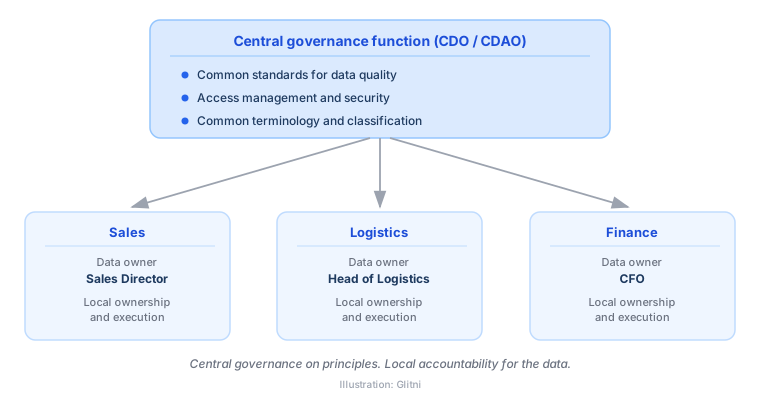
We see it consistently in the organisations we work with: those who succeed with data ownership over time have almost without exception moved in this direction.
It is more efficient. And it is easier to scale.
Why is data ownership important?
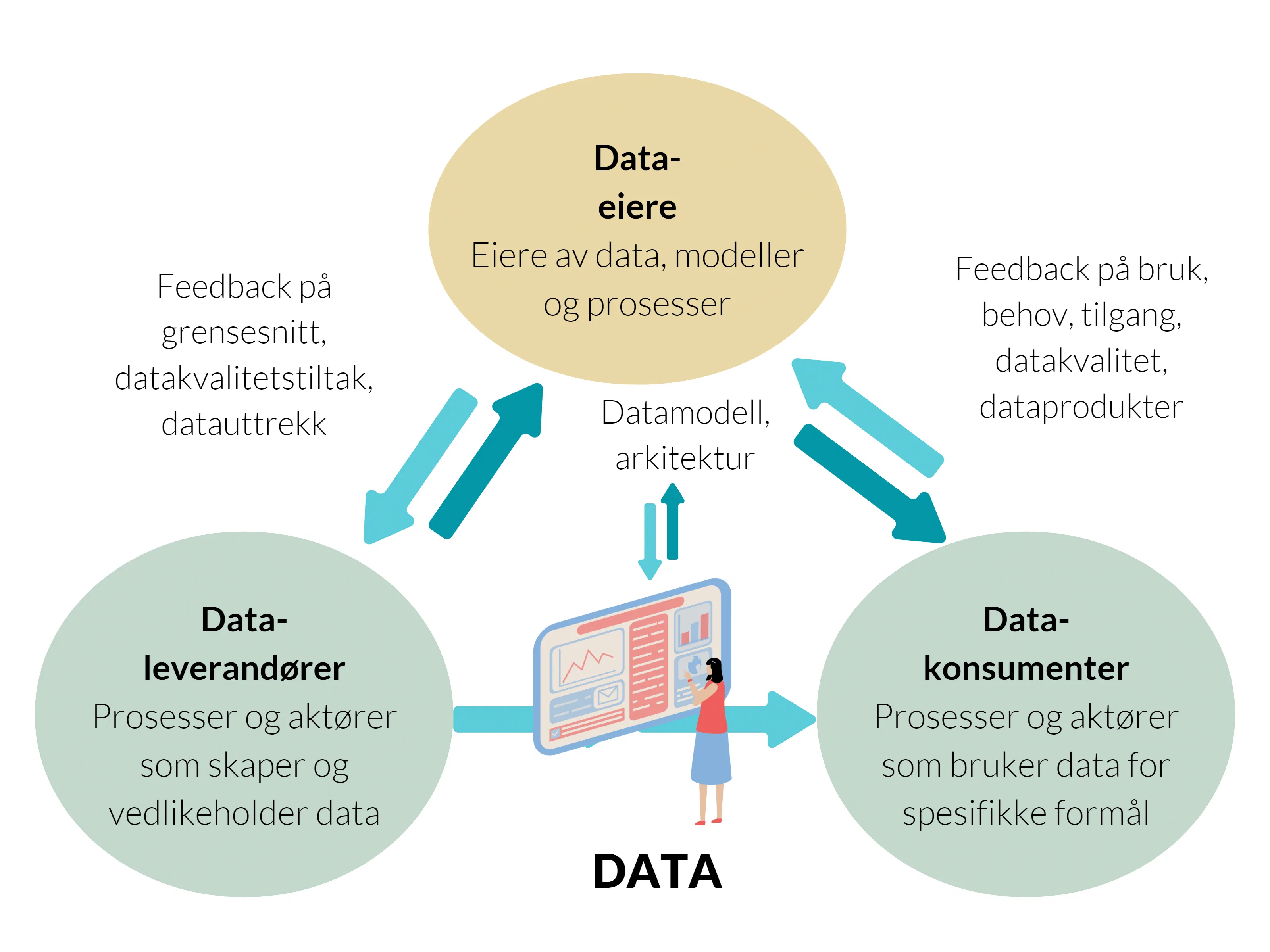
Data ownership matters for three reasons that are as relevant in 2026 as they were in 2023, but which now carry even greater weight:
Data ownership establishes accountability and builds trust in the data. A data owner is responsible for decisions about specific data: how it is interpreted, which quality dimensions apply, and what happens when something is wrong. Without this clear line of responsibility, discrepancies fall into a no-man’s land.
Data ownership contributes to consistent and correct use of data. Data owners ensure that data is collected, stored and interpreted in a standardised way. They have the best understanding of what the data actually represents, and that expertise is needed to support sound business decisions.
Data owners enforce security and privacy requirements. Some data requires extra care — because it is personal data, commercially sensitive or part of systems subject to regulation. Data owners assess the purpose of use and decide who gets access under what conditions.
The AI era demands clear ownership
The AI era has done something interesting to data ownership: what was previously a best-practice question is becoming a legal requirement.
The EU AI Act, which entered into force in 2024, sets explicit requirements for data documentation, traceability and explainability for AI systems in risk categories. To document which data was used to train a model, and who was responsible for ensuring it was correct, you need clear ownership structures. Unclear ownership is not just inefficient — it is a compliance problem.
Agentic AI amplifies this further. The more autonomously AI systems operate with minimal human oversight, the more critical it becomes that the data they rely on has clear ownership, known quality and traceable origin. The tolerance for ambiguity disappears.
We see it in projects: organisations that invest in AI without having their data ownership in order hit a wall. Not because the technology fails, but because the data it depends on cannot be trusted, and nobody knows who is responsible for fixing it.
Data owners do not work alone
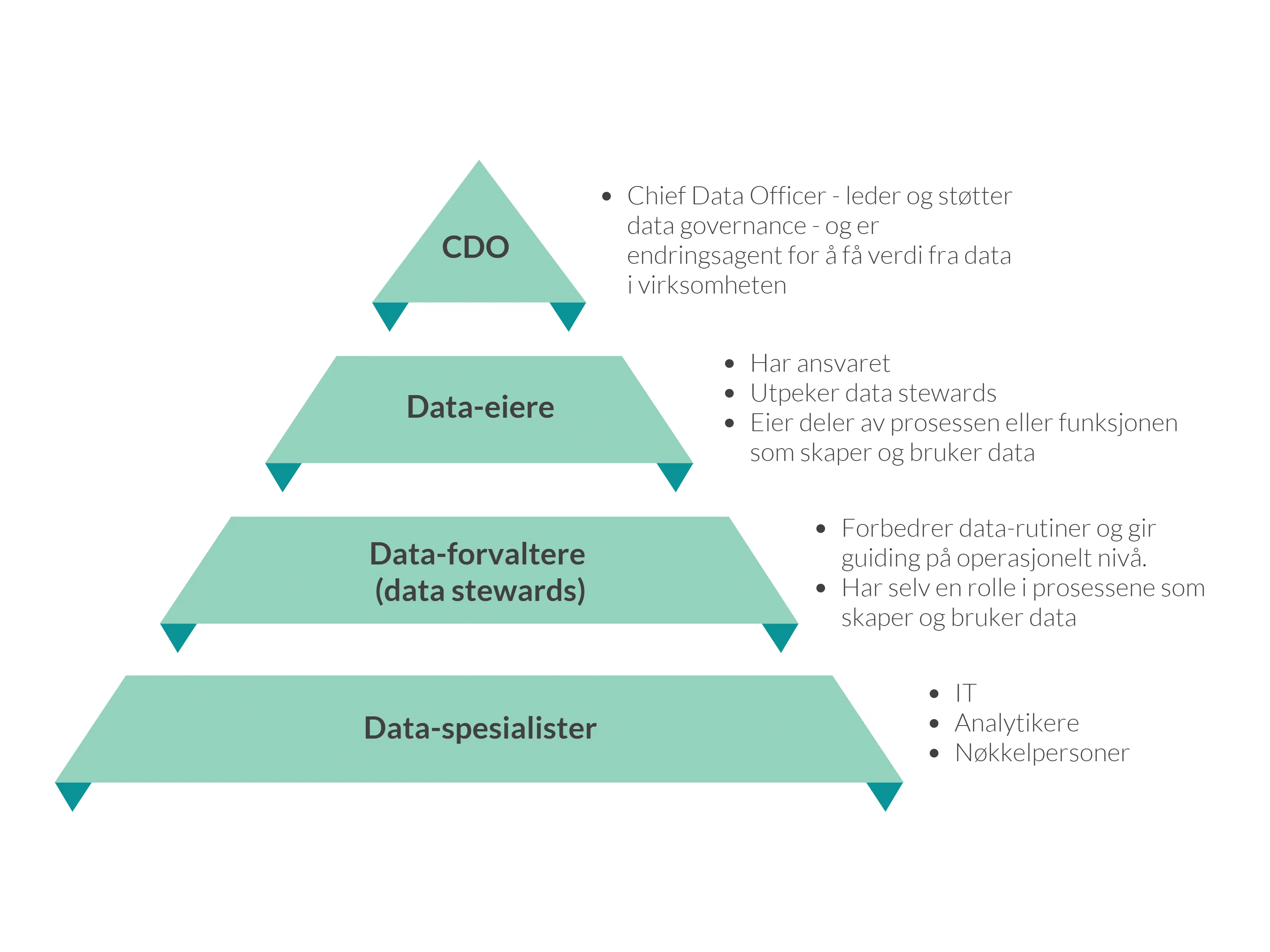
Data owners work within a network of roles:
- CDO or CDAO provides direction and legitimacy to governance work. They support data owners directly and drive the organisation to take data ownership seriously.
- Data owners are leaders in each domain with decision-making authority for data within their area. They appoint data stewards and are the primary point of contact for questions about access, interpretation and quality.
- Data stewards do the operational work: documenting data, following up on quality issues, guiding users and maintaining dialogue with system administrators about improvements.
- Data specialists within IT, analytics and process provide support as needed.
An element that has grown in importance since 2023 is data contracts: formal agreements between data producers and consumers specifying what is delivered, in what format and at what quality. Contracts make ownership operational. They define who is responsible for what, and make it possible to handle discrepancies without it becoming a political discussion.
When data ownership fails
We have seen data ownership introduced and fail. The patterns are surprisingly consistent:
Nobody takes responsibility. The data owner role is created on paper, but the person assigned has no time, mandate or priority to do anything with it. Data ownership without formal authority and dedicated capacity is window dressing.
Roles are unclear. Data owner and data steward are treated as synonyms. Who makes the final decisions and who carries out the operational work is not defined. The result is that nothing happens, because everyone is waiting for someone else to decide.
Implementation starts too broadly. Some organisations try to roll out data ownership across the entire organisation at once. It is too much to absorb. The pilot fails under the weight of its own complexity.
Leadership buy-in is missing. Data ownership is a cultural change, not just an organisational realignment. Without active support from senior management and direct involvement from the CDO, ownership drifts into being a technical exercise with no real impact.
Data ownership that is not backed by mandate and priority is not data ownership. It is job titles.
How to implement data ownership step by step
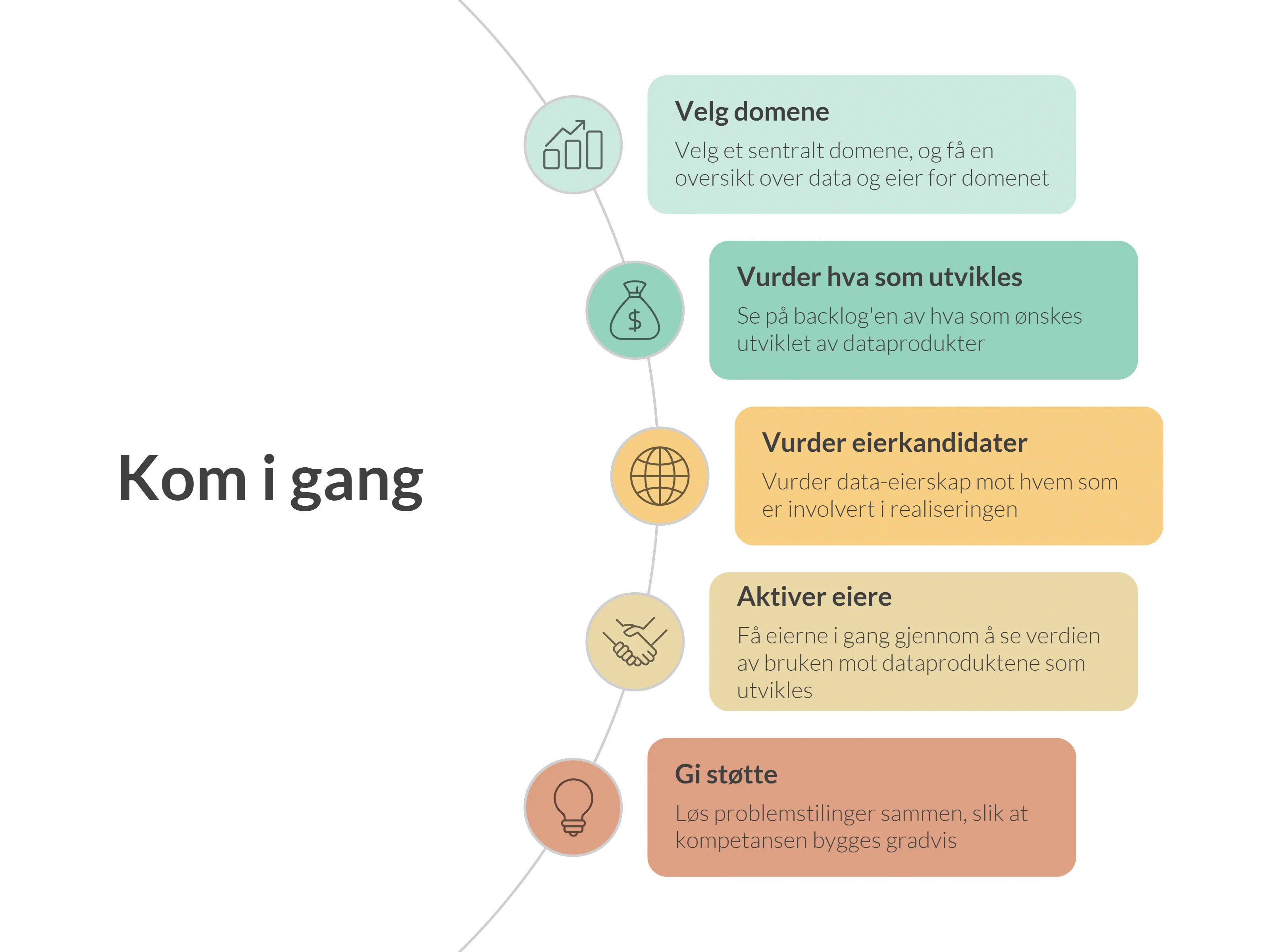
Good data management begins with data ownership. And data ownership begins in one place, not everywhere.
Here is what a CDO should do to establish data ownership:
Choose one domain. Start with a business domain with a clear owner and high data intensity — sales or logistics, for example. Do not try to do everything at once.
Map data and ownership. Get an overview of which data exists, who uses it, and who in practice is already making decisions about it. The actual ownership structure often already exists, informally.
Assess ownership candidates. Identify who has business knowledge, influence and legitimacy in the domain. A good data owner is not the most technical person, but the one with decision-making authority who can motivate others to work on data quality.
Give data owners mandate and visibility. Formalise the role. Give data owners time, executive backing and direct support from the CDO office. Set common standards centrally — classification, access management, quality requirements — but let the owner be responsible for local execution.
Build momentum through a concrete data product. Activate ownership through the development of a new data product in the domain. The owner and their team quickly discover the value of having their data in order when they see that poor data quality blocks results they themselves want to achieve.
Stay close to the owner in the early phase. The first months involve a lot of learning. The CDO and support function should remain close, so the owner builds competence gradually and can operate more and more independently over time.
There is no universal model. Adjustments along the way are expected, and that is fine. What is not fine is never starting.
Data ownership works — but only if someone actually owns it
The effect of good data ownership is tangible: we know how data should be interpreted, who has access, and we can trust the quality. AI systems can go into production because the foundation is documented. Business decisions are made on data everyone agrees on.
To get there, you need a person in each business domain who takes responsibility. Not just holds the title, but prioritises it, has the mandate for it, and gets support for it.
Want to know how far your organisation has come with data ownership? We are happy to do a straightforward review of ownership and governance model as a starting point for identifying the next steps. Get in touch with us at Glitni.
Frequently asked questions about data ownership
What is data governance? Data governance is the framework for managing data across an organisation. It covers procedures, standards and accountability structures designed to ensure data quality, integrity, security and consistency. Data ownership is the operational core: it is through clear data owners that the governance framework actually works in practice.
What is the difference between a data owner and a data steward? A data owner is a leader with formal decision-making authority over specific data. A data steward is a subject-matter expert who carries out the operational work under the data owner’s authority. The data owner decides; the data steward executes.
Who should be a data owner in an organisation? A data owner should be a leader with real authority within the relevant business domain — the sales director for sales data, for example. It should not be an IT role. The best data owner is the one with the most to lose from bad data and the most to gain from good data.
What is the relationship between data ownership and data governance? Data governance is the framework for managing data across an organisation. Data ownership is the operational core of that framework. Without clear data owners, data governance is a document without effect.
What happens when we do not have data ownership? Without data ownership, an accountability vacuum emerges: nobody knows who decides about the data, data quality deteriorates over time, and access management becomes inconsistent. AI initiatives stall because nobody can vouch for the quality of the input data. This is not a hypothetical problem — it is something we see repeatedly in organisations.
How long does it take to establish data ownership? Appointing a data owner takes a day. Building a functioning data ownership structure in one domain typically takes three to six months, depending on data complexity and organisational maturity. The critical thing is not speed, but starting with one domain rather than waiting for a complete plan for the entire organisation.