
Contents

Five places data creates value, and what AI has changed

Category: Data Strategy | Tags: #Data Strategy, #AI
Data creates value in five places in an organisation, along two tracks: insight and automation. Artificial intelligence has made automation cheaper, but the value still comes from choosing where to use the data.
Only 8 per cent of Norwegian leaders say they have measured and documented concrete gains from artificial intelligence (AI). That is the finding of a Norstat survey of 914 leaders in the private and public sectors, published by the consultancy Computas in August 2026 (KI-paradoksene 2026, in Norwegian). At the same time, six in ten private organisations in Norway are testing, using or developing AI solutions, and in the public sector the share is seven in ten, according to IT i praksis 2026 (in Norwegian).
Adopting the tool, in other words, is not the same as getting value from it. IT i praksis sees the same pattern: the gains are largely captured by individual employees, not by the organisation. At Glitni, we find that the difference seldom lies in the tool. It lies in whether the organisation has decided where the data should create value, and which track fits there.
Data creates value when it is used to increase revenue, reduce costs or make better decisions that lead to either. In practice, that happens in five places: in routine work, in operations, in products, in marketing and in planning. The value is captured along two tracks, insight and automation. On the insight track, data helps someone understand and decide. On the automation track, the data triggers the action itself.
Five areas where data creates value
Each industry has its own examples where data is central to value creation. Here are some common areas where insights from data can provide value:
- Increasing the utilisation of employees’ time and skills by automating routine tasks, for example automatic registration of accounting entries
- Making production and internal operations more efficient and sustainable, for example by understanding quality challenges or being able to predict when equipment needs maintenance
- Improving the quality of products and services, for example by gaining a better understanding of who the customers or users are and what they need, and then further developing products and services to better meet customer needs
- Working more purposefully with marketing, customer relationships and sales, for example by being able to tailor marketing to different segments
- Understanding future supply and demand, so that the organisation can, for example, maintain the right stock levels based on expected demand or plan staffing more effectively
What AI has changed in these five areas
The list above was written in early 2022, before ChatGPT was released. The areas are the same today, but AI has moved the limit of what is possible in several of them.
Routine tasks: Automatic registration of accounting entries existed in 2022 as well, but it usually required documents to follow a fixed layout. Language models can read invoices, contracts and emails that all look different, and extract what needs to be registered. Far more routine work can be automated than was possible then.
Operations and maintenance: This is where AI has changed least. Predicting when equipment needs maintenance still relies on sensor data and machine learning. What is new is that it has become easier to ask questions of the data, provided the definitions are in place.
Products and customer understanding: Much of what customers tell you is free text, in reviews, customer service enquiries and survey responses. Someone used to have to read all of it. Now a language model can sort large volumes of enquiries by topic, so people can spend their time acting on what they find.
Marketing and sales: In 2022 this was mostly about choosing the right segments. Now the content can be tailored too, because copy, subject lines and product selections can be produced in several variants and tested against each other. The bottleneck has moved from producing the content to knowing which segments are worth addressing.
Planning: Forecasts for demand and staffing rely largely on the same models as before. What has changed is who can use them. A buyer can have an AI assistant produce the purchasing report and explain why the numbers look the way they do, without going through an analyst.
Two main tracks for creating value: insight and automation
Broadly speaking, we can say that data can provide value along two main tracks: providing better insight or understanding of a problem, or helping to automate an action or set of actions. In both tracks, we can work with data using simple methods (for example visualising a historical trend), or use sophisticated methods based on advanced analytics (for example machine learning to predict the probability of customer churn).
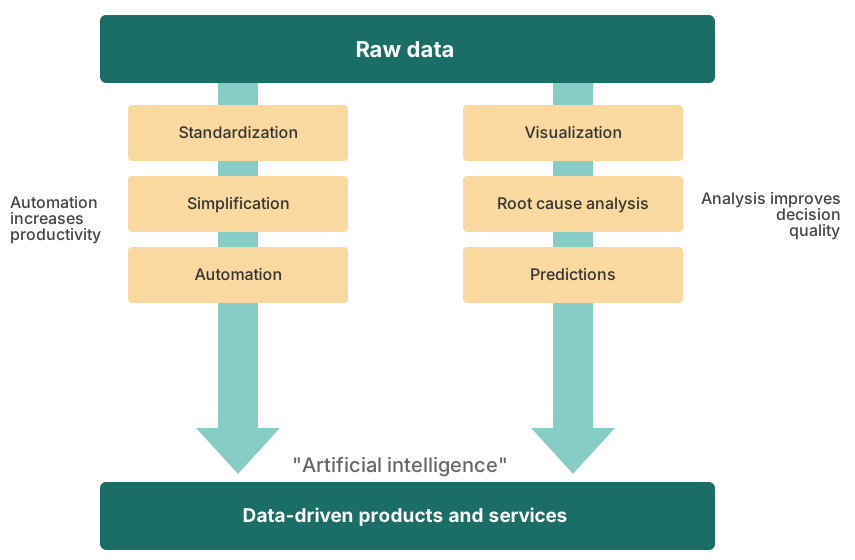
The routine tasks in point 1 belong on the automation track, and customer understanding in point 3 starts on the insight track. The other three often begin as insight and end as automation once the organisation trusts the numbers enough. A forecast that is accurate enough can eventually place the orders itself.
Generative AI has made the automation track cheaper. Tasks involving text and language, such as product descriptions, customer service replies and summaries, used to require a project of their own. Now they can be handled with tools most people already have at work. In Norway, 54 per cent of employees use AI at least once a week, and the share who never use it has fallen from 45 to 24 per cent in a year, according to Microsoft’s Work Trend Index for Norway (in Norwegian) from July 2026. Even so, the use often goes to simple tasks such as drafting text and summarising, IT i praksis finds. The barrier is skills, not access. Only 3 per cent of the leaders in the Computas survey say they lack access to AI tools, while half point to a lack of skills among their employees.
The line between the tracks is also less clear than it was in 2022. An AI assistant can find the insight and take the action in the same step. It can find the customers who have not bought anything for six months, and draft the email they should receive.
That makes it more important than ever that the data the AI acts on is correct and well described, as we show in the guide on data products as the foundation for AI. An error in a report has a reader who can stop it. An error in an automated action goes straight to the customers.
Case: Guttelus learns from its data, week by week
To make this a bit more tangible, it can be helpful to look at an example. Susanne Skou runs Guttelus.no, a Norwegian online shop for children’s clothing. I am a co-owner of Guttelus, so this is a case I know from the inside.
2020: evidence-based decisions
Before 2020, they ran the shop almost without looking at the data they had. They experienced modest growth each year, but without making much profit. The data, which primarily resided in the e-commerce platform and in Google Analytics, was not particularly complex, but it was not easily accessible for non-technical staff.
Susanne realised they needed to work in a more data-driven way, and got help to set up a small data platform and hired a dedicated business analyst, both in 2020. The investments were limited. The data was used daily to evaluate campaigns and plan marketing, target customer communications, purchase and restock goods, and set prices. This brought higher revenue growth, better stock control, more accurate pricing and better margins.
Indirectly, Guttelus also uses data for automation. Warehouse operations are outsourced to Colliflow, where the goods are stored in an Autostore system. Software controls the robots and keeps track of where each individual bin is at all times, which gives lower costs and faster, more reliable deliveries to customers.
2026: new tools, more AI
Guttelus moved the shop from WooCommerce to Shopify in June 2026. Customers receive emails through automated flows in Klaviyo, and the flows are measured every month. A weekly dashboard built on Shopify data ranks improvement actions by what they return in kroner per working hour, so a small team can spend its time where it pays off most.
The team now uses AI assistants for purchasing reports and for analysing the paid channels. They are also building alerts in Slack that flag when something looks wrong in the shop, such as products missing a description.
Many of the tools have been replaced since 2020. The most important thing is that they use the data they hold to learn and adjust, all the time.
Three questions before you choose
The choice of place and track belongs in the data strategy. Three questions can help you make it:
- Which of the five areas costs the most time or money today?
- Do you first need to understand the problem, or do you know enough to automate the solution?
- What is the smallest thing you can try within a month, and how can you know whether it worked?
How to get there, from the first reports to data used across the whole organisation, is the subject of How to create value from data: four phases, four pitfalls.
You must assess for yourselves which challenges you should tackle, but please do get in touch for a conversation about the opportunities available to you.