
Contents
The Difference Between Integration Platforms and Data Platforms

Category: Data Platform | Tags: #Data Platform, #Architecture, #Integration
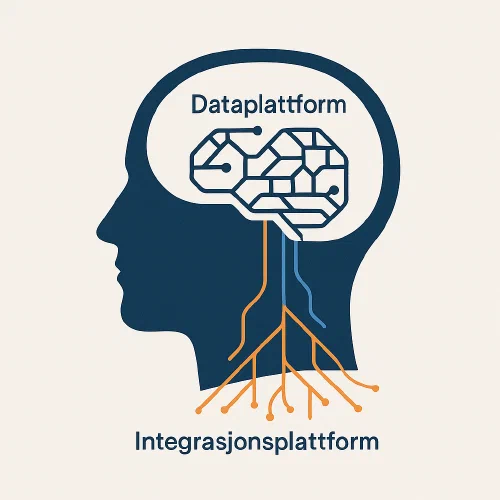
Most organizations need both a nervous system and a brain to function. In data architecture, that means one platform for integration -- and one for insight. Here we explain the difference, how they are connected, and what happens when the boundaries blur.
The Brain and the Nervous System in Modern Organizations
In many organizations, the roles between the integration platform and the data platform gradually merge. Often not with ill intent, but because it seems practical.
The data team wants to use events from the integration platform for analytics and machine learning. The integration team wants to reuse data models from the data platform in APIs. Suddenly, both teams are building stores, APIs, and event streams – and after a couple of years, you end up with two platforms that partially do the same thing, but in their own way.
The result can often be unclear roles, frustrated teams, and an ever-growing maintenance burden.
Here are typical symptoms:
- Wrong expectations: The data team is asked to build integrations, while the integration team is given responsibility for reporting.
- Duplicate work: The same data is fetched multiple times – from CRM, ERP, and sensors – without shared concepts or standards.
- Lack of ownership: No one knows who owns the customer data, and quality problems propagate in both directions.
- Technical debt: Changes in one system suddenly break something in the other, and everyone blames each other.
This is not a theoretical problem. It is happening now – in Norwegian organizations – because data platforms and integration platforms have converged technologically. Event streaming, APIs, and real-time are becoming common ground, but without clear roles, you end up in a grey no-man’s-land.
The Nervous System – The Integration Platform
The integration platform ensures that your systems talk to each other – in real time, and without drama. When a customer is registered in the CRM, she should appear in the financial system before you have time to grab a coffee. When the warehouse is empty, the e-commerce system should know it now – not tomorrow.
The integration platform handles:
- Events, messages, and APIs
- Data transformation and field mapping
- Queue management, error logging, and retries
- Transactional integrity – everyone gets the message, or no one does
The point is stability and speed, not analytics. It should react – not think.
Practical experience At a Nordic manufacturing company, the ERP system became slow every time the finance department opened Power BI. The reason was that reporting pulled data directly from the production database. The solution was to move the reporting to the data platform and let the integration platform handle the flow. The ERP became fast again – and the CFO stopped hating the BI team.
The Brain – The Data Platform
Where the integration platform connects systems, the data platform collects everything that happens – to understand and learn from it.
It handles:
- Data ingestion (batch and streams)
- Storage and modeling of data
- Data quality and documentation
- Analytics, machine learning, and decision support
While the integration platform ensures precision in the moment, the data platform ensures precision over time. Where one delivers events, the other delivers understanding.
Where the Brain and the Nervous System Meet
It is only when these two platforms collaborate that the organization truly gains momentum. But the interplay must be clear and deliberate.
Some real-world examples:
- Customer churn prediction A model trained in the data and analytics platform – for example, an algorithm that predicts churn – can be made operational through the integration platform. It runs as an API and gives the CRM a real-time alert: “This customer is considering leaving us.”
- Predictive maintenance Sensors send data through the integration platform every second. The data and analytics platform collects the history and trains a model. When the model detects a pattern that signals failure, it sends the signal back via the integration platform – and the machine stops before anything breaks.
- Data exchange between companies A supplier receives data through the integration platform, but the quality and metadata are managed by the analytics platform. This means both parties can trust the numbers.
- Real-time updates An energy company I worked with wanted “realtime everything.” After six months, they had Kafka running on everything – but no one was asking questions in the dashboards anymore. When we replaced many of the data streams with hourly batches, processing costs dropped by 50%, and no one noticed the difference.
Shared Responsibility – but Different Roles
Both platforms must handle metadata, security, and data quality. The difference is who owns what:
| Area | Integration Platform | Data and Analytics Platform |
|---|---|---|
| Time aspect | The moment | The history |
| Ownership | IT / operations | Data and analytics |
| Focus | Stability and synchronization | Insight and value |
| Technology | Azure Integration Services, Kafka | Snowflake, Databricks, Fabric, BigQuery |
| Common mistake | Excessive real-time and complexity | Too little connection to operational needs |
The integration platform should connect systems – the data platform should connect meaning.
Summary: Reflex and Reflection
The integration platform is the nervous system that makes you pull your hand away from the stove. The data and analytics platform is the brain that teaches you not to do it again.
When the two work together, the organization gains both responsiveness and the ability to learn.