
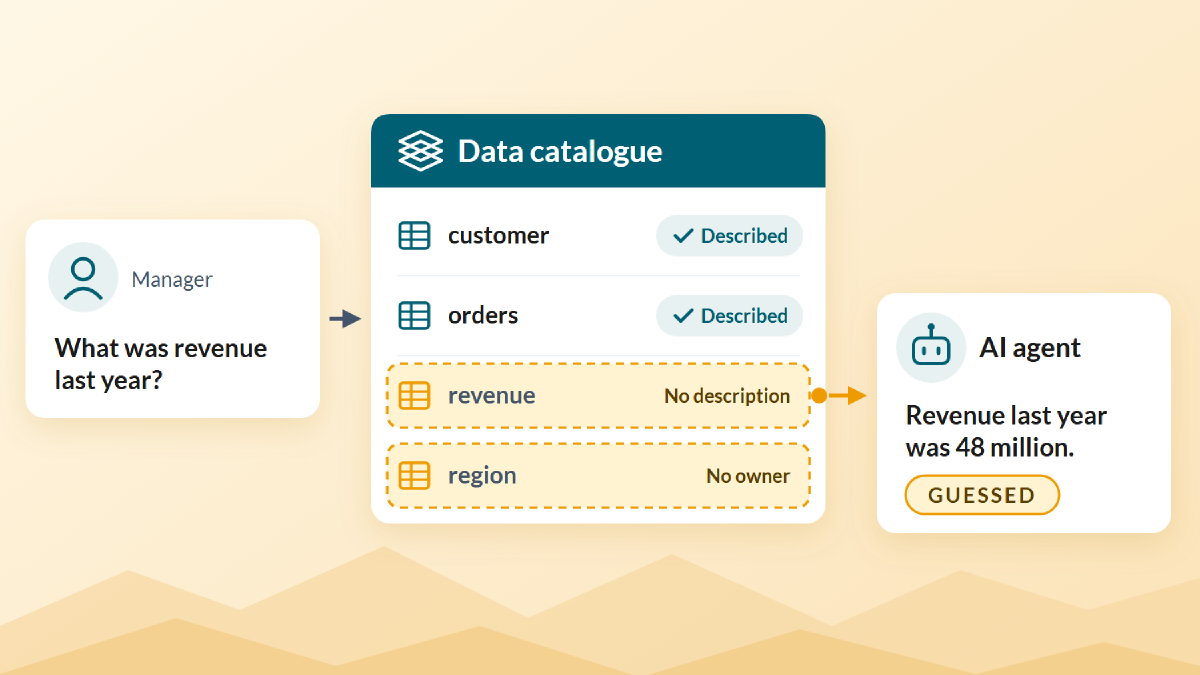
In short: AI agents make the data catalogue mandatory. They look it up every time they answer, and where the catalogue is empty, they guess. So stop measuring the catalogue by how much has been filled in, and start measuring it by whether the answers are correct. The half-filled catalogue you have is not a failed project. It is the to-do list. And a table without an owner should not give answers to either people or agents.
We at Glitni worked with a large Norwegian infrastructure company that was moving its analytics platform to the cloud. The company had a data catalogue, and it was half full. That is not unusual.
As long as the readers were people, it hardly mattered. Whoever wondered what a field meant asked a colleague. Connect an AI agent to the same catalogue today, and something else happens. The agent does not ask a colleague. It reads what is there, and where the catalogue is empty, it guesses.
A half-filled catalogue was an irritation. With agents it becomes a source of wrong answers.
The catalogue waited twice
Prukalpa Sankar is co-founder of the catalogue vendor Atlan. In a post in September she writes that the catalogue waited twice: first for someone to write the content, then for someone to come looking for it. The data changed faster than people could document it, and those who needed answers had to leave their work to look things up. Nor did the catalogue ever learn. It was measured on how much had been filled in, and that number says nothing about whether a description helped anyone.
Ole Olesen-Bagneux wrote the book The Enterprise Data Catalog and is working on the second edition. After the Big Data LDN conference he summed up what he saw as the most important points on LinkedIn in October, and the thread under the post compares the catalogue with the CMDB, the register IT operations keeps of its systems and how they connect. One of the commenters asked the question this article is about. The CMDB worked because nobody was allowed to work around it, while the catalogue is still optional. What will force it into use this time?
The catalogue has rarely lacked features. It has lacked a reason anyone has to use it.
The agent does not work around it
Sankar argues that the catalogue is not dying, but that its reader is changing. According to her, a new group of readers is growing fastest: not the analyst opening a catalogue page, but the agent trying to answer a question, investigate an anomaly or take an action. An agent in Claude or Cursor has no search box to type in, so it calls the catalogue as a tool. That job is done by MCP, the protocol that lets an AI client call services directly, with the same access rights that already govern the catalogue.
Olesen-Bagneux describes the same shift in a series of three articles. The first part, from 21 October, is titled “Phonebook for data - Spine for AI”: the catalogue goes from being a phone book for the data to being the spine AI stands on. In the second, from 3 November, he writes that catalogues are now used as a source in themselves for AI, and not only as a route to other sources.
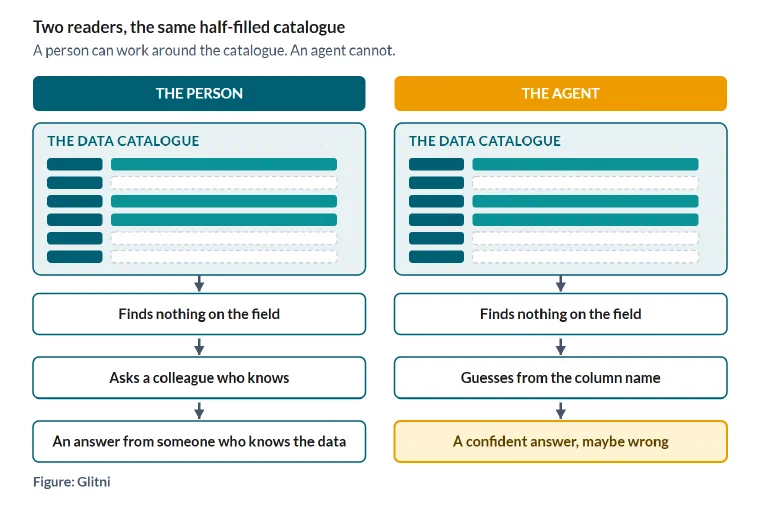
This is the answer to what will force the catalogue into use. We showed what the guessing costs in Metadata and ontology have become the foundation AI reads from. In the experiment by Data Culture, an agent with access to the tables alone answered none of 13 questions correctly. With column descriptions, 15 per cent of the answers were correct. Only when the business rules were added did the share rise to 77 per cent, with the same model throughout. With defined metrics, example queries and a fixed evaluation, the agent ended at 92 per cent. A catalogue that only describes the columns, in other words, helps little. It must also tell the agent which rules apply.
Once the agent is connected, nobody needs to decide that the catalogue is mandatory. The agent reads it anyway.
Measure correct answers, not coverage
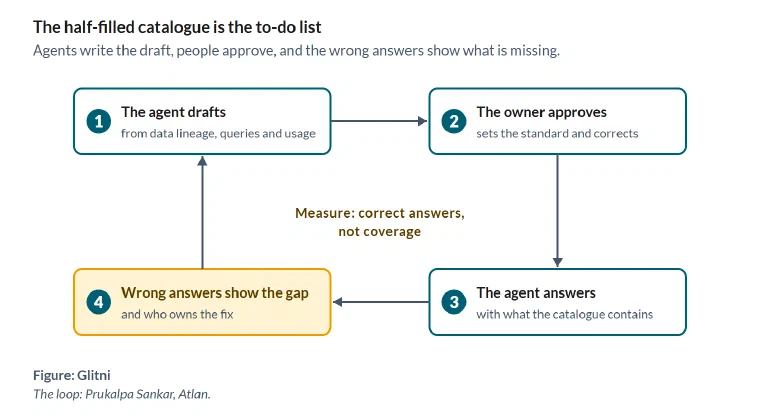
For years the catalogue has been measured on coverage: the share of tables that have a description and an owner. Sankar writes that a catalogue for agents must be measured on outcomes instead, that is, on whether the agent answers a real question correctly and can explain why. We agree. Even if the catalogue covers almost everything, the agent can get wrong what management asks about most often. A small catalogue can give correct answers, as long as it covers the tables those questions need.
As long as the catalogue was optional, an incomplete entry cost little. With agents the cost shows up at once: the agent answers wrongly, uses the wrong definition or cannot explain how it arrived at the answer. Sankar separates three failures that look the same from the outside. Sometimes the description was missing. Sometimes it existed, but no one had checked the metric underneath. And sometimes everything was in place, but the agent chose wrong. Without a trace of what the agent looked up, the team blames the model and keeps tuning the prompt.
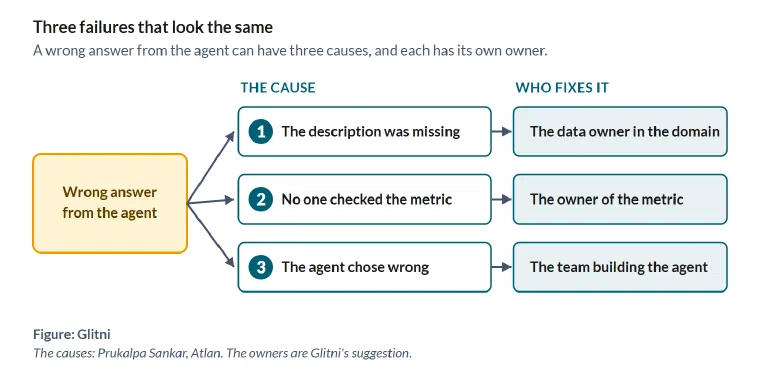
Sankar writes that each of the three failures has its own owner, but not who. That is where we go further than the source. If the description is missing, the data owner in the domain should write it. If the metric is wrong, the owner of the metric fixes it. If the agent chooses wrong, the fix lies with the team building the agent. Without that division, every failure ends up with the data team.
Malcolm Hawker is Chief Data Officer at the master data vendor Profisee. In a post on LinkedIn in November he separates meaning from truth. A semantic layer, an ontology or a knowledge graph tells the agent what an active customer is, but the agent can still query data where the same company appears five times. The catalogue stands on the same side of that divide. The correct reference comes from master data management, the core data we wrote about in Domains and owners first.
When the agent is the reader, an empty entry is no longer harmless. It is a wrong answer waiting for a question.
The half-filled catalogue is the to-do list
Many will respond to a half-filled catalogue with a new catalogue project. We think that is the wrong order. The half-filled catalogue is a to-do list rather than a failed project, and the agents’ wrong answers tell you which entries to fill first.
Sankar’s answer to who should write is that the agents write the first draft. They go through what already exists, such as data lineage, query history and usage patterns, and write a reasoned description. People set the standard, decide what is unclear and approve what can be trusted. Atlan reports in the same post that agents wrote 1.03 million descriptions across 50 organisations in three weeks, and that the quality of the company’s first AI features levelled off at around 70 per cent. Those are the vendor’s own figures, and she asks readers to read them as such. The most important part of the post is the loop: agents write, agents read, the wrong answers expose the gaps, and people fix the right layer.
Before you buy a new catalogue for AI, look at what you already have. Some of us at Glitni heard Olesen-Bagneux give the talk “The Meta Grid, Revisited” at Helsinki Data Week on 27 October. In an organisation with more than a thousand employees, the metadata already exists in many copies, he said. Information security has the risks, the data protection officer has the register of personal data, the architects have the architecture tool and the data team has the catalogue. The hard part is getting these groups to talk to each other, and neither an API nor an agent solves that. He called the problem sociotechnical.
The agents can write the draft, but they cannot take over the ownership.
No owner, no agent
We have a simple rule: a table without an owner should not give answers to either people or agents. In Domains and owners first we wrote that a data catalogue solves nothing if nobody owns the data that is to be listed in it. Agents sharpen that requirement. As long as the catalogue was optional, an entry without an owner could sit there for years without anyone noticing. When the agent reads it, the entry ends up in an answer to someone who has to make a decision.
In The data team’s harness and context matter more than the model we separated the knowledge of how the work is done from the knowledge of the data. The catalogue belongs to the second, and that knowledge belongs to those who own the data.
Start narrow. Choose the questions the agent should answer, and make the catalogue good for the tables those questions need: owner, description and business rules. The rest of the catalogue can wait until the agent needs it.
A test
Pick ten questions management often asks about the numbers, and let an agent answer using only what the catalogue contains. Go through every wrong answer and find out whether the description was missing, whether no one had checked the metric, or whether the agent chose wrong. Then write down who in the organisation owns the fix.
If you cannot answer the last part, you know what has to be in place before the agent is let loose.
The commenter in the thread asked what will force the catalogue into use this time. The answer is the agents.
Frequently asked questions
What is a data catalogue? A data catalogue is the overview of an organisation’s data: which tables and datasets exist, what they mean, where they come from and who owns them. Well-known tools are Collibra, Atlan, DataHub and OpenMetadata, along with the platform vendors’ catalogues: Unity Catalog in Databricks, Horizon in Snowflake and Microsoft Purview.
Why are data catalogues left half-filled? Because nobody has had to use them. Someone has to write the descriptions, the data changes faster than people can document it, and people can ask a colleague when they wonder what a field means. The catalogue is also measured on how much has been filled in, and that number says nothing about whether the descriptions helped anyone.
How does an AI agent use the data catalogue? The agent looks up the catalogue to find out where the data is, what it means and who owns it, before it writes a query or an answer. It does not use the catalogue’s search page but calls the catalogue as a tool, often through MCP, with the same access rights that already apply to the catalogue.
How do we measure whether the data catalogue is good enough for AI? By the share of correct answers the agent gives to questions the organisation asks, not by how much of the catalogue has been filled in. Go through every wrong answer and find out whether the description was missing, whether no one had checked the metric, or whether the agent chose wrong. Each of the three causes has its own owner.
Should we buy a new data catalogue for AI? Rarely as a first step. The metadata usually already exists in several tools, with information security, the data protection officer, the architects and the data team. Start with the questions the agent should answer, and make the catalogue you have good for the tables those questions need.
Is a good data catalogue enough for the agent to answer correctly? No. The catalogue tells the agent what the data means, but not whether it is correct. If the same customer appears five times in the data, a good definition of customer does not help. The correct reference comes from master data and data quality.
Learn more
Related reading on glitni.no:
- Metadata and ontology have become the foundation AI reads from
- The data team’s harness and context matter more than the model
- Domains and owners first
Sources and further reading:
- Prukalpa Sankar, Is the data catalog finally dead?, Context & Chaos, 8 September 2026. Figures 2 and 3 build on the post.
- Ole Olesen-Bagneux, post after Big Data LDN with the comments below it, LinkedIn, 3 October 2026
- Ole Olesen-Bagneux, Data Catalog I/III: Phonebook for data - Spine for AI, Books by Ole Olesen-Bagneux, 21 October 2026
- Ole Olesen-Bagneux, the talk “The Meta Grid, Revisited”, Helsinki Data Week, 27 October 2026
- Ole Olesen-Bagneux, Data Catalog II/III: Memory for Enterprise, Books by Ole Olesen-Bagneux, 3 November 2026
- Malcolm Hawker, post on CDO Matters, episode 109, LinkedIn, 4 November 2026
- Opeyemi Fabiyi, The Boring Work That Makes AI Analytics Actually Work, Data Culture, 28 April 2026

Magne Bakkeli is co-founder and senior advisor at Glitni. He has over 25 years of experience in data platforms, data governance and data architecture, and led the Data & Analytics team at PwC Consulting for 12 years. He has built and modernised data platforms across energy, FMCG, finance and media.