
Contents
Trends | The Landscape for Machine Learning, AI and Data (MAD) - 2024

Category: Data Market | Tags: #data platform, #AI, #dataops, #architecture, #trends
Data is used by and affects each and every one of us -- and society as a whole. That makes it all the more important that people like Matt Turck and FirstMark Capital do a brilliant job of compiling trends and technology in data and analytics, now for the 10th time.
What is the MAD Landscape?
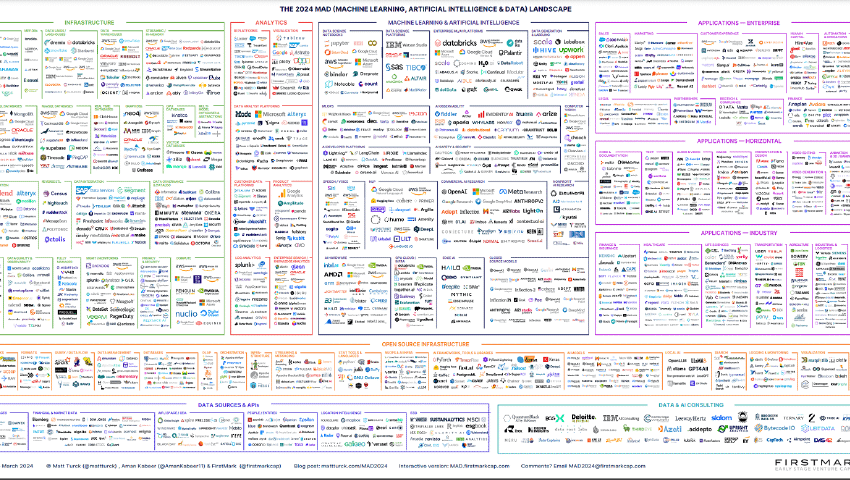
The MAD Landscape, created by Matt Turck and FirstMark Capital, is an annual report that maps the ecosystem for Machine Learning (ML), Artificial Intelligence (AI) and Data. The 2024 edition contains 2,011 companies, organised into various categories such as data infrastructure, analytics, business intelligence (BI), ML, AI applications and new categories such as AI Observability and AI Developer Platforms.
The report is divided into three parts:
- The Landscape: A detailed mapping of the industry, available in both PDF and interactive formats.
- Themes: Insights into 24 key themes for 2024, reflecting current and emerging trends.
- Funding, mergers and acquisitions: Analysis of the financial landscape, including significant funding rounds, mergers and acquisitions within the AI and data sectors.
You can find more information and explore the report on FirstMark Capital’s website.
What you need to know about data trends for 2024
Here are our 5 most important takeaways from the report.
1. Data infrastructure companies such as Snowflake and Databricks will invest heavily in AI/ML, and consolidation is coming
Infrastructure (“The Modern Data Stack”) is no longer so popular. Now the AI/ML companies are taking over in terms of valuation.
Microsoft is coming on strong with Fabric, which is described as a formidable player with a strong market message in generative AI (but: “there’s a gap between the announcement and the reality of the product”).
2. “The Modern AI Stack” is coming
An increasing number of business-critical AI/ML models need better support from the technology and data organisation than they have generally received so far.
Many use cases going forward require us to connect internal, unstructured data with large language models such as ChatGPT-4. For this, we need vector and graph databases, among many other components. We must create structure for both structured and unstructured data.
3. BI is going to get a makeover, with help from natural language via LLMs
The hope is there, but many of us are sceptical that inaccurate language models can deliver the precision we are looking for in the short term. More specialised models that perform better will most likely emerge.
4. We are clearly at some stage of an AI hype
In terms of the valuation of anything related to AI, it is absolute madness right now. Some of us were around for the dot-com bubble. This feels quite similar. We are going to experience some setbacks.
Which players will win and which will lose is quite open (Microsoft, Google, Meta, Databricks, Snowflake, AWS…). Competition is increasing, and the costs of using LLMs are coming down, thankfully.
We are going to see more large language models, which have ecosystems of technical capabilities and/or specialised, smaller language models connected to them. It is the sum of all this that will matter.
5. Traditional AI will interact with generative AI – even though generative AI will get all the attention
We will need to use both unstructured and structured data together. And therefore also traditional AI and generative AI. Do not forget that, dear CxOs out there.
Read previous articles about developments in the data market
Here you can read related articles: