
Data Platform | A Guide to Data Platforms

Category: Data Platform
A data platform collects, transforms and makes data from various sources available. Glitni provides you with an overview of what a data platform is, why you need one, and what types exist.
What is a data platform?
Let us begin with a quick definition:
A data platform is a set of services that allows organisations to collect and make data from many different sources available in one place, provide context so the data becomes meaningful, accurate and understandable, and ensure that value can be extracted through various forms of data-driven initiatives.
In other words: a data platform is a collection of technologies that ingests, transforms, consolidates and delivers data to users, applications or other uses such as machine learning algorithms or solutions that combine data with artificial intelligence.
Why do you need a data platform?
From a small startup experiencing strong growth to a small company delivering an innovative and newly established service, to a mature company with several thousand employees. We all depend on using data smartly to meet customers’ expectations for modern services. This requires a data platform in one form or another.
Let us make this more practical. You are accustomed to a multitude of data-driven services in everyday life:
- The online grocery store suggests items and accessories that suit your needs.
- The retail chain you shop at anticipates demand and adjusts staffing and inventory based on seasonal trends, weather, local conditions and customer preferences.
- The streaming service you use offers personalised recommendations that continuously improve based on your history and taste.
- The price of the taxi you book is quoted in advance, and the fastest route is selected – even during rush hour and when something unexpected occurs.
- At work, you can calculate the product and customer profitability of the goods being sold, and you can quickly make decisions about customers who should receive extra attention.
What role does a data platform play in all of this? Well – without a data platform that ingests, stores, processes and delivers data, all of these services would be difficult to realise.
Such solutions require consolidation of large volumes of data, algorithms that are intelligent and capable of being further developed for better precision, as well as a technical infrastructure that responds quickly and is easy for developers to use. The data platform makes it possible to access, govern, deliver and secure data in a consistent manner.
The data platform thus makes it possible to deliver on this use case. Without a data platform in one form or another, this would be difficult to achieve.
What can a data platform contribute?
Below are some examples of what a data platform typically contributes:
- Reducing data silos by collecting data and descriptions of data and definitions in one place
- Enabling scaling up – and down – of data volumes, data types, data products and users
- Being able to handle all types of data (ingest, store, process and deliver), so that competing data silos or extra load on operational systems are not created
- Delivering data quickly to internal users, suppliers and customers where it adds value – through data streaming
- Providing better control over data by enabling you to enforce access control and data security more effectively
- Contributing to better data quality by enabling you to monitor and improve quality from source to consumption – and ensuring that key concepts and metrics are documented and curated in one place
- Supporting development and production environments for AI, so that more advanced methods for creating value from data are also enabled (such as machine learning and LLMs)
Benefits that a data platform enables
All of the above were capabilities that a data platform can contribute – but what about the benefits?
An investment in a data platform today can yield significant returns over time through cost savings, increased revenue, greater flexibility and reduced risk:
- A data platform can contribute to a data culture through good self-service capabilities that make it easy for everyone to start using data. Easy access to data can provide better understanding and opportunities for learning – and provides facts and evidence for decision-making.
- A data platform can make it possible to reduce manual work by automating data preparation, so that analysts can spend their time interpreting results and putting improvements into action.
- A data platform can facilitate automating business processes through the use of simple business rules or more advanced algorithms (e.g. whether your loan application should be approved or rejected).
- A data platform can provide the ability to deliver better user experiences, services and products for customers, suppliers and employees through data.
For those who already have a data platform
Most larger organisations have at least one data platform, often in the form of a data warehouse or a data lake. Perhaps there are many advantages and benefits you have already realised. Great!
If there are still use cases you cannot deliver on, or other problems such as instability, a high proportion of maintenance versus new development or little control over data governance, there is reason to look at both the data platform you have today, but also other elements such as delivery model, competence, processes, data ownership – and much more.
None of these symptoms can be easily solved with a data platform alone. You can purchase the best technology and design the best architecture and still have the same challenges. A data platform, built correctly, can nevertheless be an enabler for achieving more holistic change.
A data platform can be built in several different ways
Data platforms are composed of several architectural components. Until a few years ago, a data platform consisted of an integration tool that extracted a limited amount of structured data each night, a database/data warehouse and a reporting tool on top. Now we have more sophisticated options where we can, for example, ingest data continuously in near real-time and store all types of data more efficiently in various storage services. On top, we have solutions for both visualisation and advanced analytics.
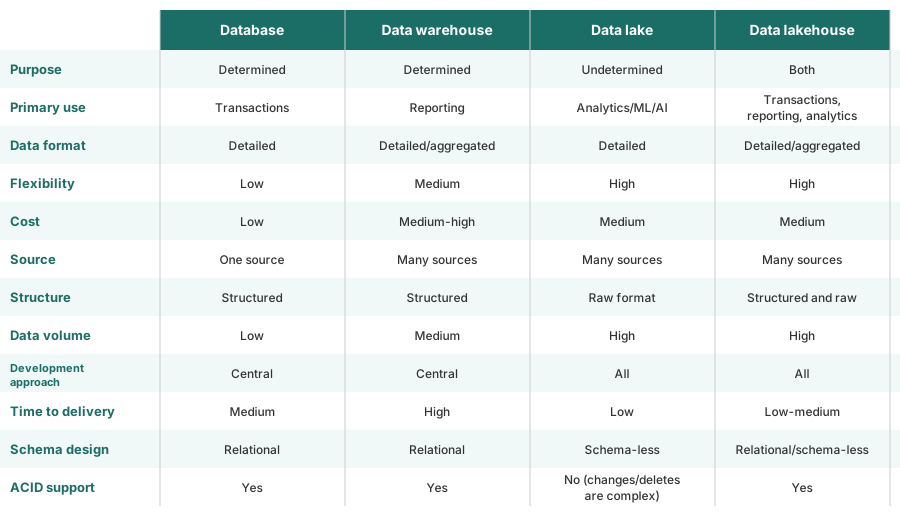
The most common forms of data storage for reporting and analytics are database, data warehouse, data lake and data lakehouse. Below we have set up a comparison of each of these alternatives:
Learn more
