
Contents

Glitni | Here is What We Learned About Starting a Consulting Company

Category: Company
Regardless of how Glitni fares in the future, we have just been through some exercises that we believe most people thinking about starting a consulting company will need to go through -- regardless of what you plan to specialise in. So we are sharing!
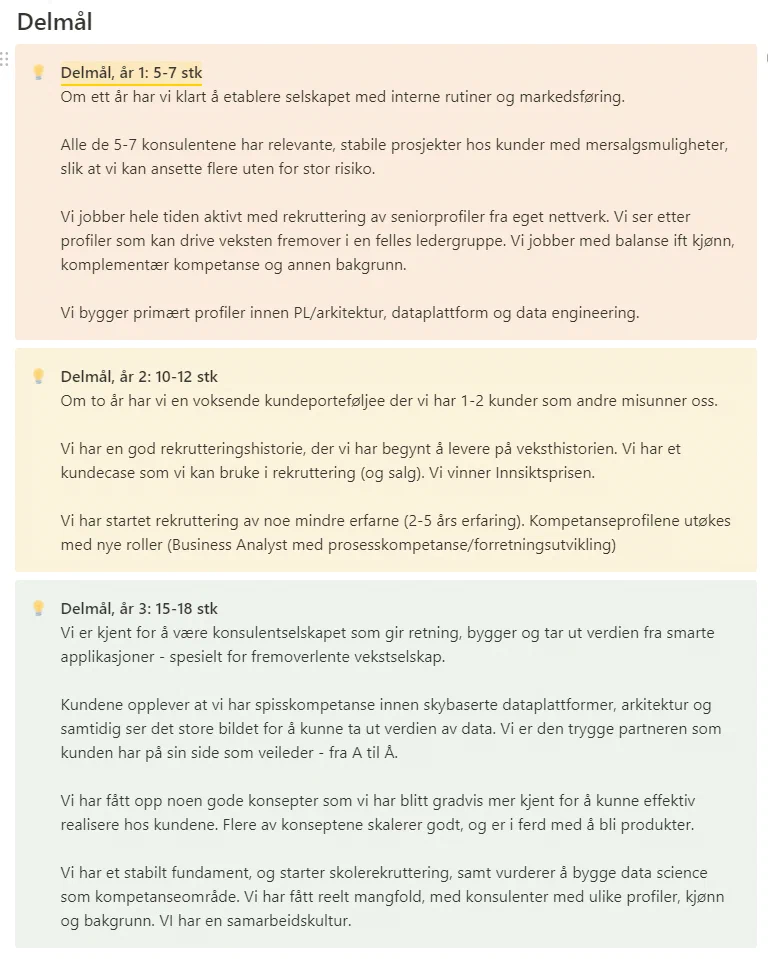
1. Agree on Common Goals
The first thing we did was talk to each other about what each of us wanted to get out of our careers and life in general – to make sure we saw the world in roughly the same way. We did this both as a group and in pairs, sometimes quite late in the evening. Perhaps many of you have done this before as well, but this time the timing was right – so right that we decided to do something about it.
In particular, we compared what each of us could gain and lose from doing something as bold as starting on our own. The opportunity cost was there, as everyone could do other interesting things, but the risk was unanimously perceived as small across the group.
We then discussed some elements that we feel constitute the very foundation of the company, where we agreed on the business model and the goals we wanted to achieve. Some of us had been thinking about starting our own company for a long time, while others needed to discuss more about what we wanted to achieve and how we would get there. So we rented a meeting room and used old consulting tricks to talk through what we considered important.
Our experience: Spend time defining a future vision for where you want to go! This is a great exercise for reaching agreement on what you are about to embark on.
2. Clarify Why Clients Should Want to Work With Us
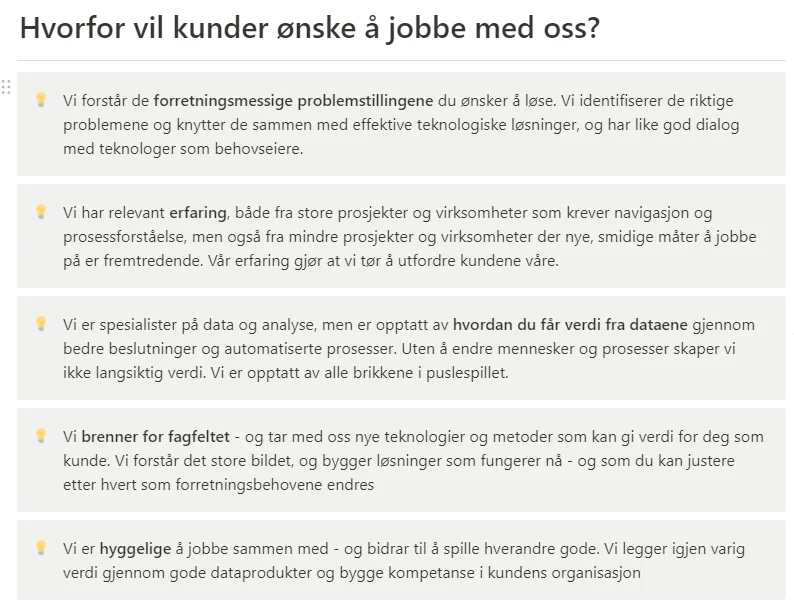
We continued to hold workshops. The next point was to clarify our value proposition. The business model in a consulting company is to sell specialised expertise in the form of billable hours to other companies that have challenges where that expertise is particularly valuable. We therefore considered what we should be especially good at, what problems we should solve, and for whom. And – should the model primarily be to sell hours, or should we generate revenue in other ways as well?
Our experience: Spend time defining the value proposition you bring to future clients. Why should someone choose to buy services from you, rather than from your competitors?
We concluded that we would start with hours and see if other models could be spun off later. And what we should be especially good at was data platforms, data products, and everything else needed to get value from data.
3. Identify Who We Should Work For
Those of us who have worked for a few years are fortunate to have a network. We made it tangible by creating a list of companies, contacts, and potential entry points to problems we could assist with. We created a database (in Airtable – you can of course create a list in Excel too). We also actively used LinkedIn to identify potential leads.
Before starting Glitni, we were fortunate enough to establish that each of us could get into engagements quickly, through 2-4 concrete sales opportunities per person. If that had been more uncertain, we would have needed to account for this when assessing our financing needs.

4. Agree on Internal Values
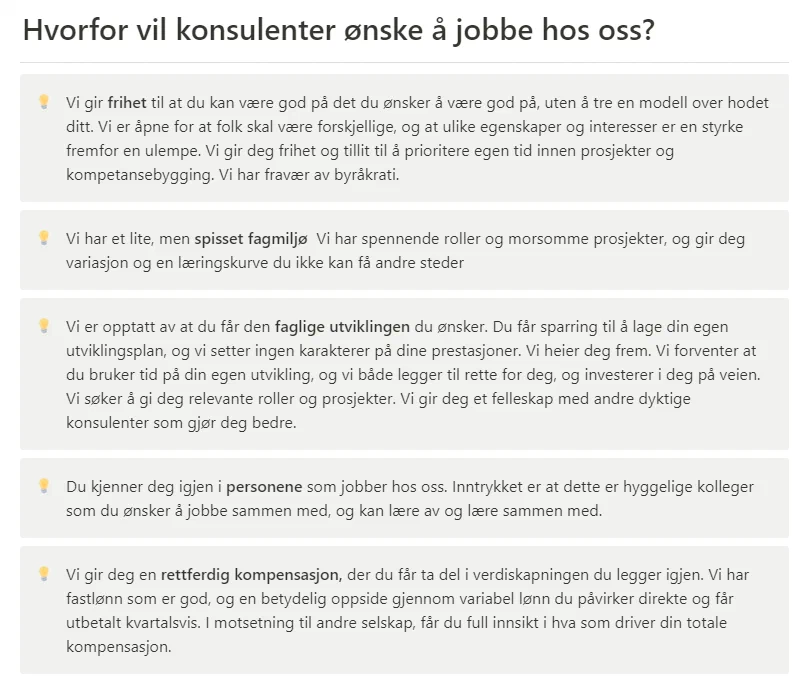
We have plans to grow, to add many more people. We therefore worked on answering why both we – and new consultants – should want to work at Glitni. We need to be clear about why someone should choose to work with us rather than staying where they are today, and not least why talented people should choose to remain at Glitni. The exercise was also valuable for ourselves – after all, we are creating the workplace we ourselves want!
5. Define How to Attract More Talented People
We had a few meetings where we tried to define which roles we wanted to fill first, and then used examples from our own network of who were good candidates. We thought (and still think) that our collective expertise is like an onion, where we should strengthen the core first before expanding into competencies we do not already have.
In practice, we created a simple database (in Airtable again) and compiled a list of 100 names who could be suited to fill the roles. We then discussed whom we wanted first and what the best approaches would be for opening a dialogue with them.
We are fortunate to know quite a few talented people, even though most of them are probably happy where they are. We plan to talk to some of them, and perhaps use job ads and headhunters later. We will see!
6. Map Out How to Build Brand Awareness
It is easier to sell our services, and also to recruit, if our brand is well known. We discussed how we wanted to present ourselves and which channels we wanted to spend the most time on. Not everything was done as a group, as we split 50/50 between the technical solution for the website and the visual identity.
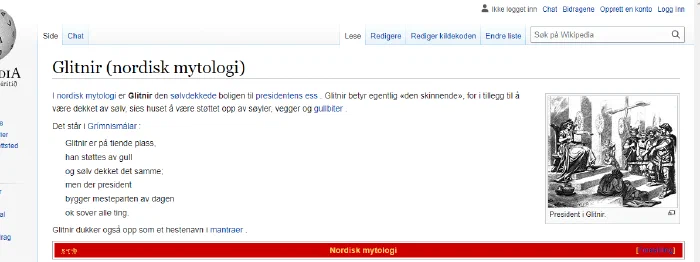
We first spent a fair amount of time – all of us together – on the name of our creation: Glitni, and what the name should represent. Namely that we are based in Norway, are trustworthy, and create gold from your data. Glitni means “the shining one” in Old Norse.
Remember to check if others are using the name! Our name is somewhat similar to an Icelandic bank that is now bankrupt, but that is not such a big deal…
We also spent considerable time on visual expression and logo. A couple of us are more than averagely interested in such things, but we believe it is worth some time regardless. This should perhaps come a bit further down the line for many, but for us it created positive energy and was something we enjoyed. We created a simple design handbook in Canva, set up PowerPoint email, logo, and bought/found images that represented the expression we wanted.
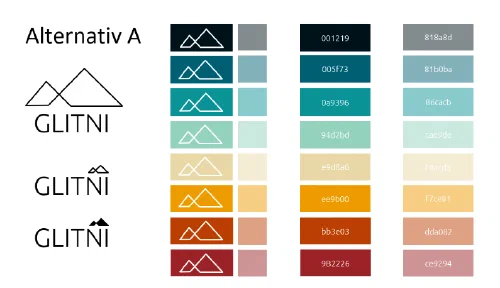
For channel selection, we spent a bit less time. We believe that B2B marketing is best done on LinkedIn, followed by Facebook and Medium. Instagram, TikTok, Snap, and the others will come a bit later for us. And not least: our professional engagement must be showcased in physical channels such as professional forums and various events. We started early sketching out a marketing calendar, but we have worked on this more since then.
7. Distribute Ownership Stakes
Agreeing on the distribution of ownership stakes is never easy. Some of us have extensive experience and networks, while others have loads of energy and eagerness to drive sales and recruitment once we are up and running. But none of us knows what effect this will have, or who will end up being most valuable.
Regardless, it is virtually impossible to get the distribution of ownership stakes perfectly fair. Our goal was to distribute them so that no one would become bitter and resentful afterwards. But we found this difficult too – so difficult that there was a period of some tension. In the end, however, we landed on a distribution we could all agree on.
8. Set Up a Shareholders’ Agreement
After settling on ownership stakes, we as the owners of Glitni set up a shareholders’ agreement. We did this before the company was formally incorporated.
Our experience: The shareholders’ agreement seems like a good instrument for avoiding potential conflicts in the future, so spend some time together to make it as good as possible!
The purpose of the shareholders’ agreement is to regulate matters between the shareholders, or subgroups of shareholders. For example, we as the founders of Glitni do not want to have passive shareholders – it is only possible to be a shareholder in Glitni if the shareholder is employed at 50% or more.
We regulate the following points in our shareholders’ agreement:
Based on our experience, we believe most people can manage to set up a reasonable shareholders’ agreement on their own, without involving a lawyer. But sometimes it is certainly necessary. Consider talking to someone who has created such an agreement before – it was useful for us.
9. Complete the Incorporation of the Limited Company
We found it easy to set up a limited company (AS), but remember that it can take a few weeks before everything is processed by the bank and the Brønnøysund Register Centre. It is also well explained how to proceed here.
In short, what you need to do to establish a limited company is:
- Fill out incorporation documents with name, purpose, owners, board, and managing director
- Open a business account for the limited company at a bank and pay in a minimum of NOK 30,000 in share capital
- Register the limited company in the Register of Business Enterprises. Upon registration, you receive an organisation number
- Register in the VAT register when you expect to invoice clients for more than NOK 50,000 excl. VAT within the next 3 weeks
10. Finally – Here is Our Task List for Starting a Consulting Company
Throughout the launch of Glitni, we have gone through many tasks. So far, we have been good at communicating along the way, with one planning meeting per week. In addition, we clarify things with each other via chat or video calls. We created a task board where we distribute tasks among ourselves across different categories, and schedule them in two-week sprints.
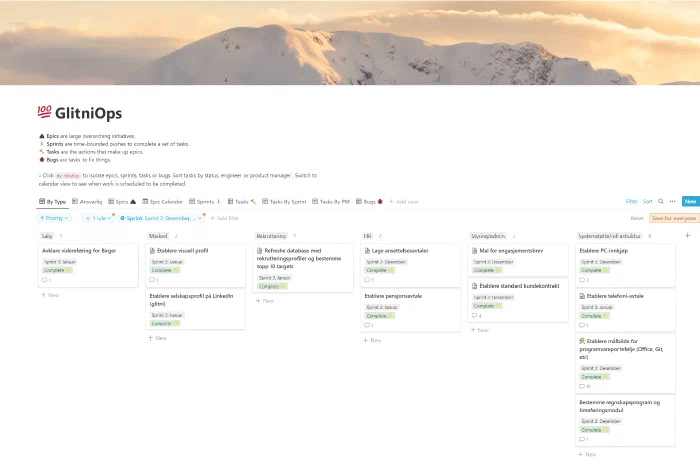
You will likely also need to go through most of the tasks we have been through. We have therefore created a task list that can be used as a starting point for launching your own company. The categories we have used so far are sales, marketing, recruitment, HR, governance/admin, and system support. Not all tasks are solved overnight, and many require several iterations. Here is the list that we at Glitni have worked through, and are in part still working on:
| Category | Task |
|---|---|
| Sales | - Create a simple CRM system - capture contacts and sales opportunities - Create templates for engagement letters and standard terms - Establish contact with client X, Y, and Z - Reach out to network within NN - Create CV template - Establish relationship with partner YY |
| Marketing | - Establish visual identity - Source images for branding - Take photos of ourselves - Write stories for LinkedIn and Facebook for the company launch - Establish website - Create company profiles on LinkedIn, Facebook, and Medium - Contact X for possible press coverage - Create marketing plan (with social media posts, advertising, press, articles, event participation, etc.) - Set up SEO tools - Set up web traffic analytics - Test paid advertising - Establish routine for analysing SEO and web traffic |
| Recruitment | - Confirm when X, Y, and Z will resign - Draft role descriptions and recruitment personas - Create contact list for further recruitment - Reach out to candidates A, B, and C |
| HR | - Create employment contracts - Establish pension agreement - Establish occupational injury insurance and liability insurance - Establish social calendar - Draft compensation and incentive model description - Establish employee handbook |
| Governance/Admin | - Create liquidity forecast and process for updates - Establish meeting structure - Align decision-making structure - Establish finance handbook with routines for time tracking, invoicing, expenses, accounting principles, etc. - Establish payroll support - Clarify office strategy - Formulate and visualise business plan - Set up agreement with auditor (later) - Establish guidelines for internal communication |
| System Support | - Clarify system support needs (documents, email, web hosting, Git, etc.) - Establish digital signature solution - Establish guidelines and solution for users and access management - Decide on accounting software and time tracking module - Establish PC procurement - Establish telephony agreement - Purchase software licences |
| Company Establishment | - Clarify personal and shared goals for the company - Agree on positioning, value propositions for clients and new employees, and the culture we want for the company - Clarify how we want to manage professional development - Establish shareholders’ agreement - Clarify internal role distribution and formal roles (managing director, power of attorney, board composition) - Establish banking relationship - Pay in X NOK in share capital - Establish AS in the entity register - Register the company in the VAT register |
If you are skilled in data platforms, data pipelines, data products, and data governance, there is little point in starting an entirely new consulting company – you might as well get in touch with us at Glitni!